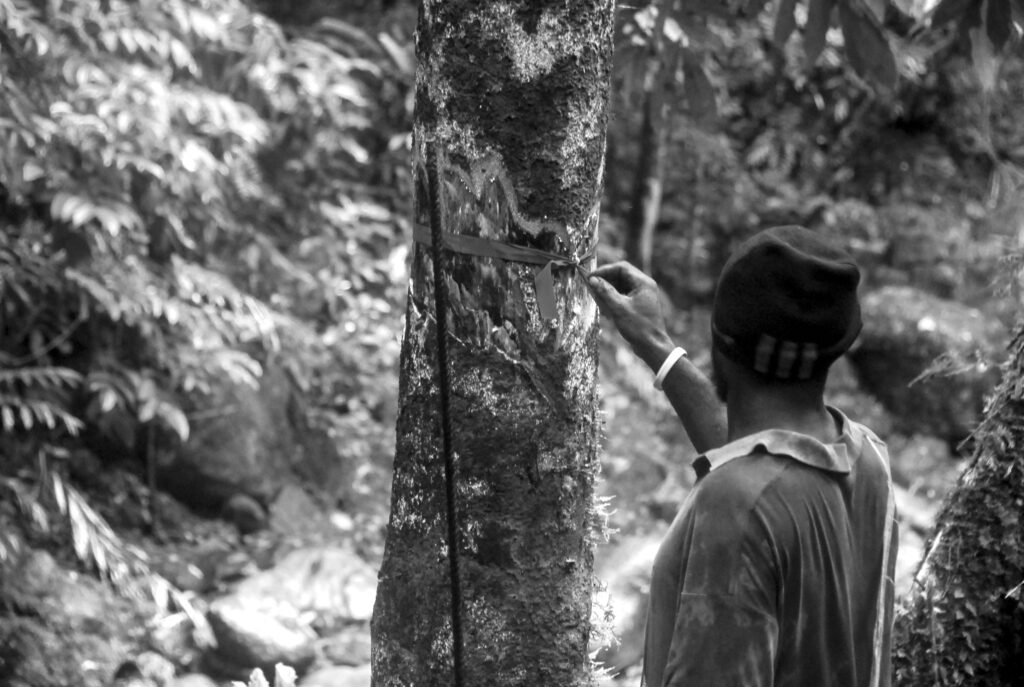
The tandaning is one of the song genres of the Wide Bay Mengen living in East Pomio, Papua New Guinea (PNG). Tandaning is derived from the North Mengen verb tandan, “to cry,” also referred to as singsing krai in Tok Pisin, the lingua franca of PNG. The tandaning songs are composed by individuals who sing about a person dear to them, often a child, spouse, sibling, or friend. It is primarily, but not exclusively, the responsibility of women to compose the songs, in which they describe particular events that involved the person held dear and that moved the composer to tears. Events and topics that inspire compositions can include the illness or death of the person whom the composer mourns, feelings of longing for an absent loved one, anger over perceived mistreatment of a loved one by others, or joy felt for them (see also Be 2021:62). I refer to the tandaning as “songs of lament,” thereby distinguishing them from other genres and registers of crying and weeping songs, as well as sung crying.
The tandaning differ from what Steven Feld (1990:242, 254–55) has called “sung-texted weeping,” namely, ritualized crying with sung text that is improvised, but which often conforms to specific conventions of the genre. Examples of this in PNG include the sa-yalab weeping genre of the Kaluli (Feld 1990); the sorara of the Korafa (Gnecchi-Ruscone 2007); the pukupuku kaŋapla, “grief-crying,” of the Awiakay (Hoenigman 2015:158) or the Duna’s khene ipakana, “death songs” (Gillespie and Hoenigman 2013:99); and the sung weeping of the Lau-Baelelea in North Malaita (Karongo Hundleby 2017:255–56); along with the Karelian itkie iänellä, “to cry with voice” (Silvonen and Stepanova 2020:205, 207), and the worded ritual wailing of the Bororo of Brazil (Urban 1988:391). In these genres and registers, the singers or weepers cry the text as the event takes place, such as during a wake (Karongo Hundleby 2017:255–56) when the body of the deceased is brought home, as shown and examined in Darja Hoenigman’s (2015:160) excellent multimodal analysis of Awiakay weeping, or even during men’s departure for the army, one reason for Karelian weeping (Silvonen and Stepanova 2020:205).
The Wide Bay Mengen also perform—or observe—”sung-texted weeping” upon death. When a person dies, preparations for the funeral and the associated mortuary ceremonies immediately commence. The deceased is washed and laid out in their house, where closely related women sit around the body and cry.1 If the women know how, they also perform sung-
1 The house of the deceased and the adjacent tent for mourners is called mamtengpun, “the root of death,” in Mengen and haus krai in Tok Pisin.
23
text weeping called teleglik in Mengen.2 During a wake, people come and pay their respects to the body, which is usually buried on the next morning after a mass.3 After the burial, the close kin of the deceased hold ceremonial exchanges, which I describe below in more detail. Unlike the crying at a wake and sung-texted weeping in general, the tandaning are composed after an event has taken place and after the initial emotion has subsided. The tandaning thus resemble Papua New Guinean lament songs, such as the Binandere guru (Waiko 1986), the Biangai yongo ini or “women’s songs” (Halvaksz 2003:156), and Rauto death poems (Maschio 1994:208). The Binandere guru are songs composed after the mourning period ends; they stem from the initial worded crying to develop into songs with a standardized structure, as noted by John Waiko (1986:24, 29; 1990:342–43). The tandaning also have a standardized structure of one or two verses and a repeated verse or chorus, along with a text set by the composer that is subsequently recalled and rehearsed.
In this article I present an overview of the tandaning genre and situate the songs in their sociocultural context. To my knowledge, the Wide Bay Mengen tandaning genre has not been analyzed in scholarly literature before. However, ethnomusicologist Francis Be (2021:62–64) discusses related tandaning songs of the Mengen of Jacquinot Bay in Central Pomio in his article on the transmission of ancestral knowledge in songs. I do this, first, by introducing the Wide Bay Mengen and East Pomio, and I then describe my field research, during which I recorded and translated thirty tandaning songs with the help of Mengen interlocutors, who also explained what the songs were about. In the following section, I discuss the ceremonial contexts in which the tandaning are performed. Within these, social relations of care as well as relations within and between matrilines are reproduced and made visible through ceremonial gifts—and the tandaning songs.
After discussing the ceremonies, I move on to discussing the songs as texts by focusing on the avoidance terms used by the composers and then discuss plant metaphors. Both avoidance terms and plant metaphors are closely tied to Mengen questions of sociality, and, in the case of plants, to the central role of plants as both recipients and media of care. In the final section, I discuss how the tandaning can be used to voice not only personal sadness or grievances, but to discuss relations within and between matrilines. Here, a song about the emergence of logging in the Wide Bay describes disagreements occurring within a matriline.
In this article I show that the tandaning are both emotive expressions of valued social relations and a medium through which these relations are reproduced. Both in the content and in the context of their performance, the tandaning express interpersonal relations of care as well as ties within and between matrilines. As media of social relations, especially within and between matrilines, the tandaning resemble valued plants, which feature in the songs and gifts presented in ceremonies during which the tandaning are performed. Since the tandaning are composed by individual people about events that moved them, with old songs remembered and new ones
2 I have personally observed sung-texted weeping only a few times. In 2024, Josephine Matapoeng noted to me that teleglik is not considered singing, but a form of crying.
3 The Wide Bay Mengen are, for the most part, Catholic. In some villages there are congregations of Seventh Day Adventists and revival churches. During my fieldwork in Wide Bay, I witnessed funerals and mortuary ceremonies performed by Catholic Mengen.
24
composed, these songs of lament also represent expressions of continuity and change in Mengen society.
The North Coast Mengen
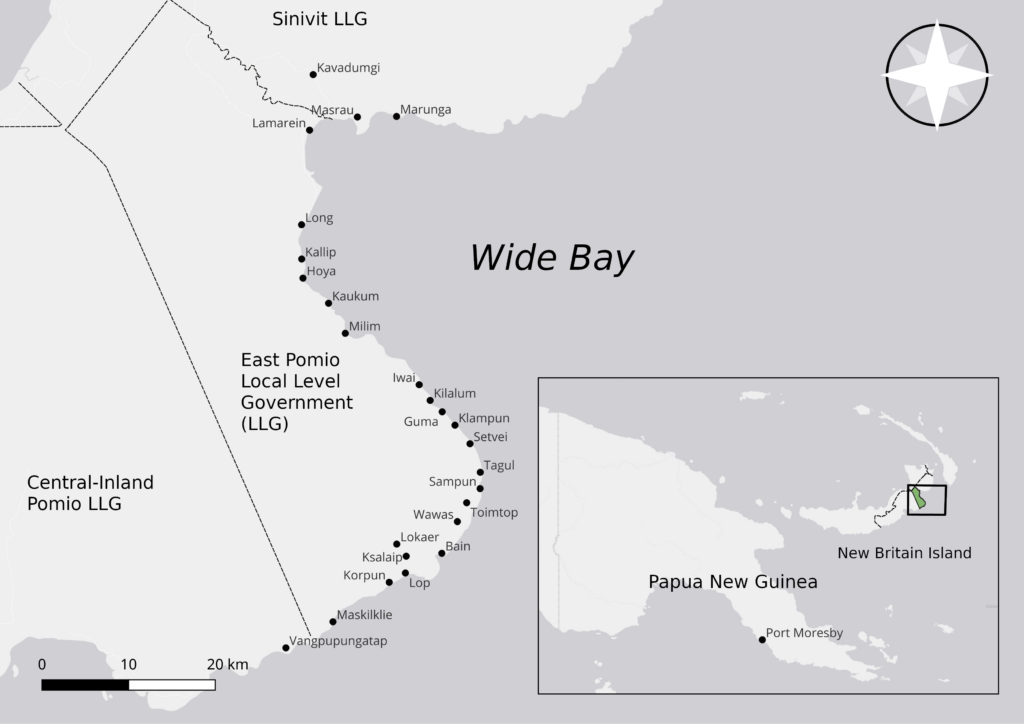
Speakers of Mengen live in the Pomio District of East New Britain Province, Papua New Guinea (PNG). The Mengen language consists of three main dialects: North Coast Mengen (also Orford Mengen, or Maeng), South Coast Mengen (Poeng), and Inland Mengen (Longueinga), although some linguists classify North Coast Mengen as a distinct language (Lewis et al. 2015; also Be 2021:56). Speakers of North Coast Mengen live in the eastern part of Pomio on the coastal area between Waterfall Bay in the south and Wide Bay in the north. This article is based on research I conducted in the East Pomio Local Level Government area hosted by North Coast Mengen speakers. The North Coast Mengen speakers of East Pomio live in eight village communities between Maskilklie and Tagul in the southern part of Wide Bay around Cape Orford and in Lamarein ward in the northwestern corner of Wide Bay, with a population of about 2,500 people (NSO 2014:17; see Map 1). The Mengen of East Pomio speak a distinct dialect of North Coast Mengen. As such, I use the term “Wide Bay Mengen” to distinguish them from
Map 1. East Pomio and the Wide Bay area (1:400,000) (map by Tuomas Tammisto).
25
other Mengen-speaking groups. While the expression is mine, it is based on local conceptions of linguistic differences.
The Wide Bay Mengen rely mainly on swidden horticulture for their livelihoods, and they earn money through small-scale cash cropping, migrant labor, and occasional compensation from logging. Like many inhabitants of rural PNG, they communally own their lands under a customary land title. Mengen society is divided into two exogamous moieties (Mengen: val, “vine”) and a number of named matrilineal kin groups, which are called “vine branches” in Wide Bay Mengen (valmtan, lit. “type of vine” or valsin, lit. “small vine”) and commonly referred to as “clans” in English and Tok Pisin (klen). Each person belongs to their mother’s clan, and the clan affiliation does not change during their lifetime. In turn, each clan belongs to one of the moieties, and marriages with members of one’s own clan or moiety are forbidden.4
Each clan has its own history, which tracks the genealogy from the apical ancestress through subsequent clan members, noting their intermarriages with other groups and where they settled. Many clan histories recount how the ancestress emerged from the land or inhabited it alone in a particular place. These origin places are called plangpun (plang: “to emerge, break”; pun: “root”). Each clan claims a territory of its own based on the plangpun and the first settlement. The Wide Bay Mengen territory is divided between clans, which are the basic landholding units (Tammisto 2018:12–13, 48–55, 66–70; also Be 2021:64). Due to clan exogamy, all Mengen communities, from households to villages, are necessarily multi-lineage groups. While each matriline is in charge of its own territory, people often live on and cultivate land that is not their clan’s. Through their dwelling activities, people establish strong relations to the land regardless of their clan membership (see also Scott 2007:213, 218). These land-using groups, such as hamlets, are often originally based on a core of people from the landowning group and surrounded by affines, patrilineal descendants, and “various protégés” (M. Panoff 1970:193). The North Mengen term for this group is rglie (“shield”), and it is this group that is mobilized to help during feasts and, in the past, in warfare.
Mengen relatedness, communal life, and land use are based around the following two social constituencies: the landowning matrilineal clan and the land-using multi-clan rglie group (see Scott 2007:33, 201–02, 218 for a similar case). On the one hand, the clan needs to emphasize its integrity and ownership of its land, while, on the other hand, in order to reproduce itself, it needs to establish socially productive relations with other clans—that is, clan members need to marry people from other clans, settle, and use the land together. As Michael Scott (2007:33) has noted for the Arosi of the Solomon Islands, who share a very similar form of organization, communal life is about balancing these two principles. The autonomy of the matrilineal clan and the productive interrelations between the clans can be seen as two fundamental values in Mengen society, which lie in a complementary tension with one another (Tammisto 2018, 19–21; see also Jorgensen 1981:204; and Robbins 2004:192–93, 195–96). As with similar value antinomies, in order to pursue one, one needs to pursue the other—for example, to reproduce the clan, one must pursue relations with other clans—although emphasizing one value too much may hamper the
4 This structure is common to all Mengen groups, but the Wide Bay Mengen have their own clans. The Wide Bay Mengen have close relations with the Papuan Sulka speakers living north of them, and the Sulka share the same social structure based on two moieties and matrilineal clans, as do many other societies in Island Melanesia (see, for example, Scott 2007; Eves 2011; and Martin 2013).
26
other. This might occur in relation to decisions over the utilization of a tract of land when excluding those who garden there because they are not landowners, which can damage inter-clan relations.
Establishing social relations both within and between clans is understood by Mengen as “work” (klingnan), and consequently pursuing either kind of value is “work.” Thus, “work,” as understood by the Mengen, comprises activities such as caring for others, which manifests itself prototypically by giving food, gardening as a prerequisite for food, and the holding of socially reproductive ceremonies, such as initiations, marriage prestations, and funerals. The tandaning describe these valued relations and, as I will show, their performances are both expressions of these relations as well as media through which they are reproduced.
Fieldwork and the Recorded Songs
The material for this article consists of thirty tandaning songs I collected during fieldwork conducted in 2011–12 and 2019.5 When discussing traditional songs with two elder men, Bernard Maktman and Joseph Saimoteip, in 2011, they explained that, while they knew the lyrics, in some cases they did not understand them fully because they relied on archaic language.6 The songs were sung “generation after generation,” as one of them noted, but the possible intended meanings of the ancestors often remained unknown. The lament songs, or tandaning, are, however, an exception. The lyrics, while poetic, are in a language understandable to the singers and listeners, and often the backstories to these songs are known. Old songs composed several generations ago are remembered, and people compose new songs about their relatives and friends.
I became interested in the genre for two reasons: first, because the lyrics have clear expressive meaning and because their intention is often known; and, second, because the tandaning are most often, although not exclusively, composed by women. I suspected that the song texts would provide an interesting lens through which to understand what people consider important and, especially, how women perceive social life. Gender represents an obvious and important social division within Wide Bay Mengen society, despite daily interaction between genders remaining relaxed. However, as a man, I was often directed towards the male sphere by default. Thus, I sought to find ways to become familiar with women’s perspectives, not because I equate “gender” with “women,” but in order to avoid treating the male sphere to which I was assigned as the baseline for Wide Bay Mengen society and in order to avoid a highly gendered perspective.
5 In 2011–12 and 2014, I completed a total of fifteen months of fieldwork in East Pomio for my Ph.D. research on natural resource extraction, land use changes, and social reproduction, mainly in the communities of Toimtop, Wawas, Baein, Sampun, and Tagul. In 2019, as a postdoctoral researcher, I conducted six months of fieldwork, primarily in Toimtop and Lamarein, on the relationship between natural resource extraction and state formation.
6 In this article, I attribute songs to named composers. Since they are publicly performed, the Wide Bay Mengen consider these songs to be both in the public realm and belonging to their composers. I also name my interlocutors in most cases to give them appropriate credit.
27
I collected the songs by asking proficient singers to sing tandaning songs to me, to help me write down the lyrics in North Mengen, and to translate them into Tok Pisin. With the help of nine women and two men from the Toimtop, Wawas, Baein, and Sampun villages, I collected and translated a total of thirty songs. During these sessions the singers also explained to me the context of the songs, namely, the events that led to their composition and, if they knew, when the songs were first performed. As noted, women perform tandaning songs publicly during initiation ceremonies accompanied by drums or when practicing for the ceremonies. During the translation sessions, the singers sang the songs to me unaccompanied, sometimes tapping the rhythm with their fingers on a bench or on the ubiquitous lime containers people carried for chewing betel nut. Of the thirty songs, I tape-recorded twenty-nine: twenty-seven during the translation sessions and two as they were performed during a ceremony.
My interlocutors sang to me both songs they had themselves composed as well as songs they knew. The thirty songs were composed by nineteen different persons: twelve women, six men, and an unknown composer in one case. The tandaning are relational, given that the composer mourns another person. This relationality is sometimes explicated by conventional phrases, such as, “I cry for my son.” In fourteen songs the person mourned was a child of the composer, in six a sibling, and in six a friend or a relative, while a grandchild, parent, and spouse, respectively, were each mourned in one song. In one case the object of mourning was a “we,” referring to the composer and their lineage. The majority of the songs (twenty-one of thirty) were composed by women. In seventeen songs a woman mourns a man, in four songs a woman mourns a woman, in six a man mourns a man, and in two a man mourns a woman. The causes for mourning a person included the absence or departure of the individual mourned in nine songs, death in nine, accusations or disputes in six, injury in three, and illness and joy, respectively, in one song each (see below, Table 1, for an overview).
Gender relations:
Nº songs
Relation to composer:
Nº songs
Reason for crying:
Nº songs
Woman mourns man
17
Child
14
Absence and departure
9
Woman mourns woman
4
Sibling
6
Death
9
Man mourns man
6
Friend / relative
5
Accusation or dispute
6
Man mourns woman
2
Grandchild
1
Injury
4
Unknown
1
Parent
1
Illness
1
Spouse
1
Joy
1
Unknown
1
Unknown
1
Table 1: Overview of the 30 tandaning songs.
28
The Tandaning Songs and Their Performance
1. Mamteng re pasapge ae Pengkainre tongo ya se gele oe C. Ya tandane goitaku, o Loge glili te 2. Mamteng re pasapge ae Agluke ya ne Minsailon7
1. This illness struck My strong man, I do not see him, oh C. I cry for my child, oh, My thoughts return to him 2. The illness struck him, and Pulled him into Minsai
This song, composed in the late 1990s by Chris Lelengvail, was sung to me by Chris’ sister, Josephine Matapoeng, who also explained that Chris composed this song out of grief caused by his son’s death. Chris’ song exemplifies several common features of tandaning songs. First, they are composed by a person who is often the explicit narrator of the song, as is indicated in the above example by expressions such as Ya tandane (“I cry”). Another defining feature of these songs is that they are about specific persons, often referred to by their relationship to the composer, such as “my child,” and using affectionate expressions, such as “my strong man” in the song above. Third, the tandaning recount particular events concerning the composer and the person about whom the song is sung. Here, Chris describes how his son fell ill and died, namely, how the illness “pulled him into Minsai,” the origin place and abode inhabited by deceased members of his son’s matriclan. The reference to the son’s clan relates to a further important feature of the tandaning, namely, that they are publicly performed by women during initiation ceremonies, the most joyous of the Wide Bay Mengen’s ceremonies and events, in which social relations surrounding care and nurture are explicated and reproduced. Below, I will examine these features of the tandaning in more detail.
While tandaning songs are composed by both men and women, only women perform them publicly during initiation ceremonies. The Wide Bay Mengen mark three kinds of lifecycle event with major ceremonies: initiations, marriage exchanges, and death. During initiation ceremonies people are brought into the sphere of gendered personhood. In the first initiations, children of about seven years of age are initiated as boys and as girls, and in the second, youth in their late teens and early twenties are initiated as women and as men. The initiation proceedings include parts that remain secret from the other gender, ritual cleansing ceremonies, and public ceremonies held in the village. The initiation ceremonies last in their full form for three days, and
7 In this and other examples quoted below, verses are marked with Arabic numerals and the chorus or refrain marked by “C.”
29
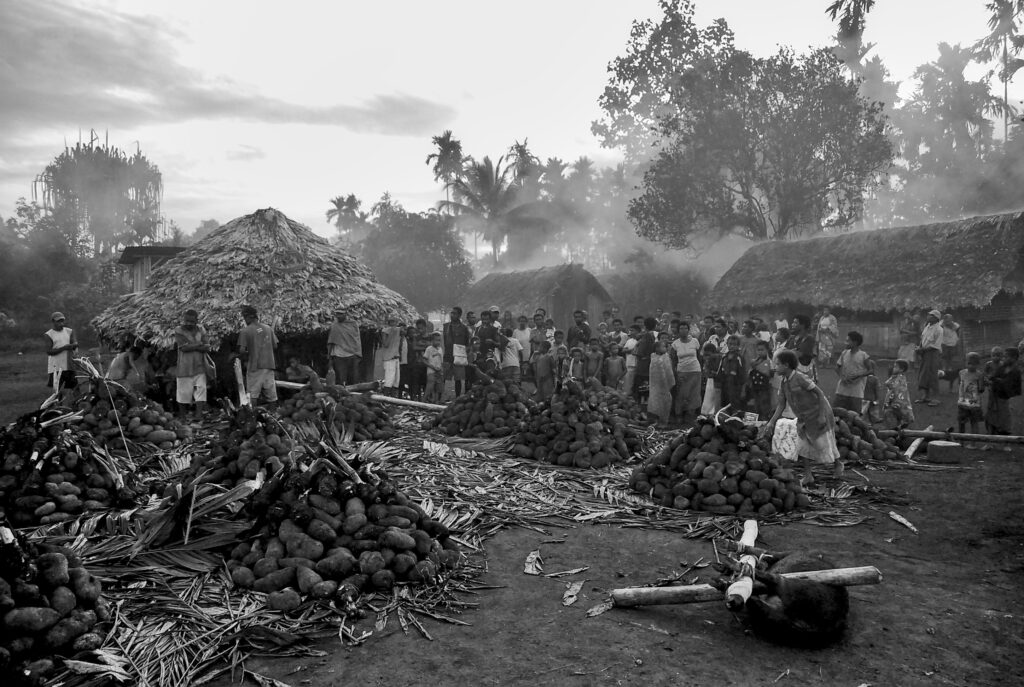
they include night-long dances and singing, culminating in the dance of the avlu, a spirit figure and male secret (Tok Pisin: tubuan), in the village and ceremonial gift prestations.
Fig. 1. A ceremonial gift prestation in front of the round men’s house in Wawas village (photo by Tuomas Tammisto, 2011).
1. Mankun ae Viakaunre Kololge tongo kaivang ke e C. Yo kesange chukpe, ya gele varsaipo guchenge Mankunre ragun e malam kurumge naname 2. Ya kenken nge gingerelon Re rige galile louk te chuckpe e
1. The village of Viakaun Searches after the sound of her laughter C. I search for my daughter and see the akcheng disappear into the distance The face of the village has changed after her mother[’s departure] 2. I sleep inside the men’s house on the bed My thoughts [lit., belly] turn to my daughter
30
This is an old song, composed by a man from the now abandoned village of Viakaun. The man longs for his daughter, who was married to a man from the Sulka village of Setvei. According to my interlocutors, Melchior Loait, Josephine Matapoeng, Otto Tniengpo and Paul Vengva, the composer had been working in his garden when his daughter’s husband’s kin came to accompany her to Setvei. When the man returned to Viakaun, his playful and happy daughter had already left. He was overcome by sadness, since he no longer heard her laughter, and he later composed this song about that situation, as noted in another discussion by Maria Sarik, Jocinta Gane and Josephine Chongmanman.
The initiation ceremonies and marriage prestations are held either in September-October during one of the primary periods for harvesting yams, or in December-January during the main harvest of taro (see also Tammisto 2019:250). Initiations and marriage prestations are coordinated between village communities in order to avoid any overlaps during the festive season. The initiations are organized by the immediate family of an initiate, their extended families contribute to the gifts, and the entire village community takes part in organizing the festivities. Whether ceremonies are held in a given community during a given year thus depends upon whether the families of that village have “work” (Mengen: klingnan) to do, to use the Wide Bay Mengen expression for socially reproductive activities, which includes the holding of the ceremonies (Tammisto 2018:12, 37–39, 54–55). In smaller villages ceremonies might not be held yearly, while in communities with more inhabitants yearly festivities are more likely. The initiation ceremonies and the marriage exchanges are joyous celebrations (Mengen: pnaeis; Tok Pisin: singsing). For a comparative view, see Francis Be’s (2021:62,65) discussion on ceremonies in Jacquinot Bay.
All ceremonies—initiations, marriages, and funerals—include gift-giving, where the organizers give shell wealth, pigs, garden food, and cloth to selected guests. During bridewealth exchanges the exchange partners include the matrilines of the husband and wife, but the gifts are gathered by and distributed to the wider kin group. During initiation and mortuary ceremonies, the immediate family of the initiate or of the deceased give gifts to individuals who represent important and formative relations to the person being initiated or memorialized. The ceremonial gifts emphasize, make visible, and reinforce both intra- and inter-matriline relations and other relations based on care and nurture, often called “hard work” (Mengen: klingnan ti main).
The initiation of a person includes the ceremonial gift and, in the case of full-length festivities, the dance of the avlu (“big man”). The avlu are male secret and spirit figures, who begin residing in bush houses (Mengen: rabail) a few weeks before the festivities. Men who hold initiation ceremonies for their children gather at a rabail, and during a busy season a single community might hold several such gatherings. During the height of the celebrations the avlu of each family holding a ceremony comes and dances in the village in front of the men’s house, which serves as a ceremonial center where the gift prestations are held. Neighboring households usually have a shared men’s house, such that even small village communities have several men’s houses. The individual avlu have names, which the men shout out after their dances. These names often refer to mythical stories, which the avlu’s appearance also depicts, and the names are often place names referring to the locations where the stories occurred. The avlu, and the stories and relations they represent, are linked to the initiate—by referring to the place of his or her matriline’s land or recounting the matriline’s origin.
31
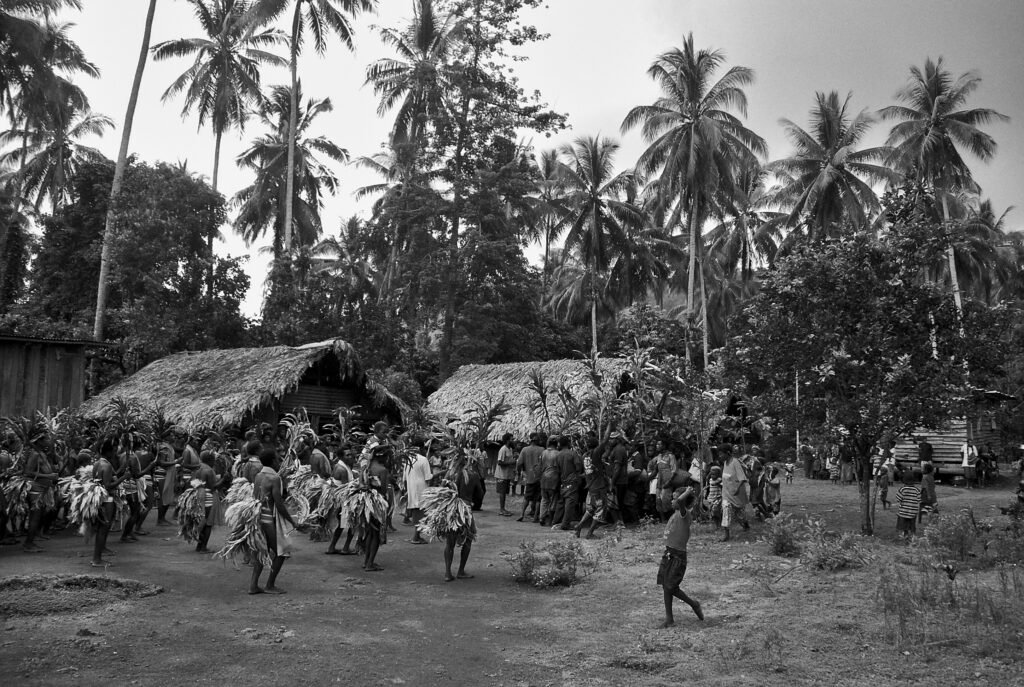
During an initiation ceremony women sing the tandaning songs accompanied by drums in front of the men’s house. Their singing attracts the avlu, which is accompanied by a group of singing men. The singing of the women and men blurs together, they stop, the avlu dances, and the men shout its name, after which the avlu returns to the bush house. Like the avlu and the gifts, the tandaning also relate to the initiate.
Tandaning that are sung to attract the avlu are about the initiate and the people related to him or her. For example, the song by Chris quoted at the beginning of this article was first sung at the initiation of Chris’ wife’s sister’s son, since he is from the same matriline as Chris’ wife and their deceased son. Like the various recipients of a gift, the different tandaning sung for an initiate index relations and events that have been formative for the initiate. The tandaning are about people held dear, but they can mention places, such as villages where the events occurred, or, as in Chris’ song, a matriline’s place of origin. Hence, the tandaning can situate not only people and the events recounted in them, but also groups—much like the avlu, which bears the name of important places (see also Be 2021:64).
Fig. 2. Women in full dance attire (left) sing tandaning songs to attract the avlu, hidden amidst the group of men (right) in Baein village (2012). Note the Cordyline plants held by women and men. (Photo by Tuomas Tammisto.)
The tandaning songs have a clear structure. They include one or two verses and a chorus or a repeating verse. Only six of the songs I recorded comprised a single verse and a chorus; all of these were sung to me by the same woman, who also composed some of the songs she sang. I
32
do not know if this song structure represented an individual stylistic choice or whether she omitted the second verse. The basic element of a song is the verse-chorus pair, in which the verse is sung once and the chorus is sung twice. One interlocutor noted that the pair is sung once with the first and once with the second verse. This specific structure was followed by several others during our recording sessions. Another interlocutor noted that during performances, the verse-chorus pair is sung twice with the first verse and then twice with the second verse. An elder woman who sang one of the songs to me followed this structure as well. In the transcriptions, I have marked the two verses with 1 and 2, respectively, and the chorus, or repeating verse, with a C. In the two songs I recorded as they were performed in a ceremonial context, the verse-chorus pair was sung twice with the first verse and once with the second (1 Cx2 1 Cx2 2 Cx2), after which another song was performed with the same structure. Sung in this way, each song lasted around ninety seconds. The two verses and the repeating verse or chorus are sung by the whole group of women performing the songs.
As noted, the tandaning differ from many of the registers classed as sung “laments” or “weeping” songs in that they are not ritualized crying improvised during an event (see, for example, Feld 1990:242, 254–55; Urban 1988; Hoenigman 2015:158; Karongo Hundleby 2017:255–56; and Silvonen and Stepanova 2020:205, 207). Rather, the tandaning have a set rhythmic pattern, and each song is composed prior to its performance by the composer, who is also the narrator of the song. Before their first performance during initiation ceremonies, the composer teaches the song to the women who will perform it. Following their performance, some of the songs are recalled and passed on as set texts by the composers and the women who performed them. In fact, the tandaning go counter to four “key principles of the oral-formulaic theory associated with Parry, Lord, and their followers” (Feld 1990:254), as summarized by Ruth Finnegan (1988:88–99, quoted in Feld 1990:254): (1) variable and occasion-dependent text; (2) composition-in-performance; (3) transmission during an event; and (4) no concept of authentic text. This results from the tandaning having precomposed set texts, which are deliberately taught by the composer to the performers.
There is a seeming paradox in the content of the tandaning and the context of their performance. The tandaning recount events that caused their composers to experience sadness, grief, anger, or longing. Many of the songs are about the death of, injuries to, or perceived injustices encountered by a loved one, but they are performed during the most joyous celebrations. By contrast, song, music, and loud noises, as well as work, are strictly forbidden following a death. The first mortuary ceremony is held immediately after the burial of an individual, and, during it, the hosts announce a period of mourning lasting from several days to well over a week, after which work is again permitted. When people organize initiation and marriage ceremonies following a death in the village months earlier, they give a small gift to the deceased’s relatives to recognize their sorrow and “open” the joyous period.
Name Avoidance and Metaphors in the Tandaning
1. Re gugikpe no kolpe mgueing pge you Yo tar yo longne kailgnang
33
C. Ya tope nge kaipkaip pnais iyo Ya kesagne mamraisme no rim 2. Re lige no kolpe nge pangome no kolope maisme Avlushinke avlumeke re lu ye Wawas nga vail
1. My sister-in-law, you rise to talk to me [scold me] I sit and listen to you work [speak to me] C. I sit sorry here amidst the festive work In vain I look for the avlu’s ornament afterwards 2. My brother, you rise with different ornaments and shapes The avlu’s pendant and the avlu’s bathing water are both buried in the village of Wawas
This is one of several songs composed by Anastacia Manmneout of sorrow over the death of her brother in the early 1980s. In this song she describes both how she longs for her recently deceased brother and how her sister-in-law scolds her. The song was sung and translated to me by Alberta Guptaol, the daughter of Manmne’s deceased brother, and Josephine Matapoeng, who did not know exactly why Manmne was scolded by her sister-in-law.
The person about whom the tandaning is sung is never mentioned through the use of their proper name (see also Silvonen and Stepanova 2020:205; and Stasch 2002 and 2009:77). In general, as a sign of respect, the Mengen avoid referring to other people by their proper names. Instead, they either use general terms, such as “the man;” relation terms, such as “my cousin;” playfully affectionate nicknames, such as “man of the bush;” or teknonyms, such as “so-and-so’s mother.” The avoidance of proper names is not absolute, and one exception includes the use of children’s proper names in teknonyms. Showing respect through avoidance, however, is particularly pronounced in in-law relations, especially between sons- and mothers-in-law, who often avoid each other physically, as well. A son-in-law may quietly exit a house when his mother-in-law enters, or the mother-in-law may deviate from a path if she sees her son-in-law approaching. Rupert Stasch (2009:85–87) has noted that avoidance is hard work, thereby emphasizing the importance of the relation. This applies to my interpretation of the Mengen, as well, given that the extent of avoidance indexes the level of respect.
The avoidance of names and references to relations are known features of sung laments (see, for example, Hoenigman 2015:163; and Silvonen and Stepanova 2020:205). For example, Darja Hoenigman (2015:163) noted that the Awiakay of East Sepik, PNG, avoid the name of the deceased in their sung crying, lest their spirit returns and harms people. Similarly, Karelian lament poetry featured a large avoidance lexicon, which was used to refer to tabooed terms and concepts referring to family relations, the lamenter herself, certain objects, food, and drink, as well as the realm of and verbs describing birth or death (Silvonen and Stepanova 2020:205, 210). In the tandaning, place names, relations, and happenings that moved the composers are not avoided, but are often referred to explicitly. For instance, the songs quoted thus far refer explicitly to illnesses, place names, and people by their relations to the composers. Some of the songs I recorded also mentioned the proper names of younger relatives in order to refer to another person along with their relation to the named individual.
34
In the songs I recorded, death was not directly mentioned, but the death of a relative was described in various circumlocutions. In his song Chris explains how illness pulled his son into the abode of his clan’s dead. In other songs death is referred to as the drying up of a plant or, as in Manmne’s song above, as the burial of the avlu’s bathing water and ornaments. The avlu appears only during the initiation ceremony, and the ornaments used by it are discarded after its dance. They are thus short-lived, and, in my interpretation, reference to them is also an icon of the temporality of human life.
In the tandaning the composers often refer to the person they sing about using affectionate circumlocutions. Some metaphors used for the person can be valued objects, such as tael (a string of shells used as shell wealth), main momon (lit., “bird feather,” referring to the feather ornament of the avlu), or avlushinke (an ornament worn by the avlu made of fragrant plants). Similarly, people were referred to as birds (gou: pigeon (Ducula rubricera and Ducula spilorrhoa); mre: eastern black-capped lory (Lorius hypoinochrous), men or women of renown (akteip and akcheng, respectively), or using affectionate expressions such as raigvailko (“my beautiful-faced one”). Plants are also often used as metaphors for the people mentioned in the tandaning. From the thirty songs I recorded, twelve included one or several botanical metaphors.
Plants are used as metaphors for people in the tandaning songs following three main logics. First, the plants’ physical features can iconically represent the person. In the songs I recorded, dark-leafed plants, such as the purple songmoail flower or purple cordyline varieties, and light-leafed plants, such as the yellow-leafed rin (Evodia anisodora), were used as metaphors for people with darker or lighter complexions. “Icon,” as I use it here, refers to a sign that bears a formal resemblance to the signified (Parmentier 1994:4, 6). In this case, the dark color of the plants refers to the skin tone. Similarly, the drying up of plants was used as an iconic metaphor for a person’s illness or death. As Gertrude Mguellelin explained to me in Tok Pisin:
So sapos em bilak man, bai yu ukone, bikos ukone em i bilak. Ukone kwa. Olsem yu, ol i laik wokim singsing long yu, bai ol i kolim rinkman, bikos skin bilong yu i yellow olsem rin.
So if it’s a black [dark-skinned] person, you use ukone [a dark taro variety], because the ukone is black. Ukone kwa. Or like you [referring to the author], if they wanted to make a song about you, they would call you a branch [lit., “hand”] of rin, because your skin is yellow like the rin.
(Recorded January 7, 2012.)
Second, some plant varieties are associated with specific matrilines, and people can be likened indexically to the plants associated with their matriclan. In this case, I use “index” to refer to a semiotic relation where the sign and the signified are physically or contextually connected, such as by occurring at the same time (Parmentier 1994:4, 6).
Third, people were referred to as valued plants in order to emphasize their importance to the composer. Certain plants, especially food items such as taro and yams, as well as plants with ritual and decorative uses such as the Cordyline, songomail, or rin, are highly valued by the Mengen. The tending of gardens and plants carries practical, aesthetic, and moral value (F. Panoff 2018 [1972]:46–48, 171), and tended plants represent central media communicating social
35
relations and the materialization of history (Tammisto 2018:12–13, 40–44, 64) for the Mengen. The Mengen thus associate people and the plants they tend in several ways and express these associations not just in tandaning poetry, but more broadly. See also Francis Be’s (2021: 62–67) discussion on the passing on of environmental knowledge in Mengen songs. In the next section I discuss the relationships between plants, people, and the tandaning in more detail.
Plants, People, and Poetics
1. Bisop me pater me mo tosin nga ganu loloun Mo kiki pge ne mlou lon re C. Re deip e re e kolope e lala pamoure E lala, e lala techungmilgne pge mo 2. Krirpak imo svugme gokpikse ma kukchung Totaipkam na re rakaimun mgueng mamtan
1. Bishops and priests, you are in the company of the leaf of the ganu You call him to you out of the group of people C. The man of renown rises and walks the path He walks, he walks, to give himself to you 2. Krirpak with her grandmother gathers all sorts of taro And gives the rakaimun to the different languages
This song was composed by Rospita Mrei for her brother-in-law, Eric, who was ordained as a deacon in the Catholic Church. Through this song, Rospita expresses her joy over the ordination: a joy, however, mixed with longing and sadness, since upon becoming a deacon (and later a priest), Eric leaves his family, devotes himself fully to the church, and will be assigned to a parish that may be far away. The song was performed in the Sampun village in 2011 during celebrations held when Eric gave his first mass in his home village as a newly ordained priest. Along with gift prestations, singing, and dance performances featuring several avlu, the celebration deliberately resembled an initiation ceremony. In the first verse Rospita refers to the deacon as a leaf of ganu, a variety of the Cordyline (Mengen: el; Tok Pisin: taget), which the bishops and priests summon. In the chorus she calls him “deip,” derived from akteip, referring to a “man of renown” who walks along a specific path: namely, the aisle of a church. In the final verse the deacon is likened to the rakaimun, a variety of taro associated with the deacon’s clan, which his niece and mother hand over to foreigners—that is, those who speak different languages.
The relationship between people and the plants they tend is personal and involves direct interaction. Women told me how the taro feels in their hands when they weed it, an act which allows the plant to grow. One could also interact directly with plants through garden magic, which is widely albeit not universally practiced. Thus, the relationship between plants and people
36
Fig. 3. A taro plant (photo by Tuomas Tammisto).
is one of mutual nurturing. The Mengen verb pnge refers to the growing and tending of plants, but also to caring for children and domestic animals. The relationship is mutual, since people—particularly women—care for and nurture food-item plants and, then, use those plants to care for and nurture one another. Acts of giving, especially the giving or sharing of food, represent the prototypical forms of care among the Mengen.
Since, much like children, women tend and care for food-item plants, plants are, unsurprisingly, associated closely with those who tend them. This was evident, for example, in mortuary practices. When a woman dies, her taro is sometimes uprooted, placed on a platform (Mengen: songom), and left to rot. This emphasizes the absence of the deceased: since she is not there to care for her relatives anymore, her taro, which she used in caring for others, also rots away (see also Fajans 1997:69; and Laufer 1962:450). For the same reason the relatives of the deceased might forbid themselves foods the deceased individual fed them as a sign of mourning. This food avoidance reminds them of the care the deceased provided them. Avoiding central foods takes much effort from a mourner as well as from those around them, since people must remember who can eat what and what one can offer to whom. Thus, the avoidance of foods emphasizes relations in the much the same way as the avoidance of relations discussed above (see Stasch 2009:85–87).
In addition to matriclans, some named varieties of food-item plants can also be associated with specific persons who in one way or another contributed to the variety—if only by buying it
37
from a town market and introducing it to the village. Others are associated with deceased persons who appeared in the dreams of the living and told them where new, wild varieties could be found, while certain sweet potato varieties were named after the women who found wild varieties, took them into their gardens, and domesticated them (see also Schneider 1954:287; and F. Panoff 2018 [1972]:47–48).
Each woman and many men have their own distinct “collection” of different sub-varieties of plants. Some are associated with specific clans and others, as noted, with specific individuals. Food-item plants are inherited from parents. Upon marriage a woman usually receives plants from her affinal kin, and people receive new varieties in many ways: for example as ceremonial prestations; as gifts from friends, brought back from travels; or after being bought in town. Gertrude Mguellelin, quoted above, explained how plants were given:
So desla tovail, pastaim mi no save planim. Nau Martha, em i meri Vgar, na em i save kasin bilong mi Alberta, em i papa bilong en i Vgar. So em i givim en, em i givim Alberta … na nau, kasin bilong mi i kirap na givim mi. Bikos kasin bilong mi Alberta i save olsem mi kasin bilong en bikos ankol bilong ol long papa bilong mi, so em i luksave long mi na givim mi desla taro.
So this tovail [a taro variety], previously I didn’t plant it. So Martha, she’s a woman from Vgar, she knows that my cousin Alberta’s father is from Vgar. So she gave the taro to her. And, now, my cousin, she went on and gave it to me, because their uncle [mother’s brother] is my father, so she acknowledges me and gave me this taro.
(January 7, 2012)
The first part of this quote illustrates the relations between matrilines: a woman gives her clan’s taro to her cross-cousin, whose father is of that clan. The cross-cousin, in turn, passes the taro on to her other cross-cousin—who belongs to a third clan. Through these transactions the women maintained and emphasized their interrelations as cross-cousins, as well as the relations between their respective clans. Simultaneously, since all of the women acknowledged that the taro was given because it belongs to one of the clans, these transactions emphasized clans as entities. Even though this was a mundane transaction between three individuals, the logic and outcomes resemble formalized gift-giving during initiation and mortuary ceremonies, where both intra- and inter-clan relations are highlighted through gifts.
More generally, this account shows how the plants become signs of social relations. The different varieties of taro, yam, banana, sugar cane, sweet potato, and cordyline acquired through different connections in an individual collection of crops represent the materialization of the owner’s social relations with other people, or, in more technical terms, one of the material media through which these relations are communicated (Stasch 2009:22). The personal stock of foods is then an index of the person’s relations to others (see also Barbira-Freedman 2018:9; and Stasch 2003:362, 365). The diverse plant species and varieties cultivated by a specific woman on her plot are, to paraphrase Nancy Munn (1992:121), both an outcome and a sign of her relations to others. Moreover, the diversity of plants in the plot and in her collection is an icon of the diverse relations they represent (see Munn 1992:121).
38
Food crops and plants do not simply materialize personal histories and continuity, but are also tied to a more general conception of social continuity. When interviewing one of my friends on the reproduction of taro, she explained that great care is taken so that the taro varieties of the ancestors do not die out. The Wide Bay Mengen have tens of named sub-varieties of taro, several named sub-varieties of other food crops, and cordyline. The specific histories of many varieties are—to varying degrees—known. People are keen to adopt new varieties, which can be highly valued for their taste, growth, or other characteristics; however, ancestral taro varieties are often more highly valued, and their dying out would constitute not just the loss of a good crop, but also a break in historical continuity.
Tended plants are apt metaphors for people in the tandaning songs given the many ways plants are associated with people, groups, and their interrelations. The tandaning songs themselves are, like plants, also expressions of these relations. Through a song, a person commemorates another: a child, a friend, or a relative held dear. The songs performed at an initiation feature the initiate or their relatives. Thus, the group of songs sung for an initiate indexes the multitude of relations who have produced the initiate, just like the gifts of shell wealth and food plants given during the ceremony.
Mixed Emotions and the Voicing of Grievances
1. Mo panmlueik re kailmo kunken pge e Momsinge e naro valyo C. Ya lougnan kole chuge, lougnan kole ngei lomo E gel sur mguengta ngei raigmo 2. Tongamaro susugung re mom re Re tonga mguetot po tailgne
1. You three, you chide him As if he were of another vine C. I mourn my son, I mourn him amidst you He just looks down in front of our faces 2. Oh, if his ancestors were alive They would answer the talk for him
This is a song composed by Martina Gomeyan, who sang and explained it to me in 2012. In the song, Gomeyan refers to a meeting in the 1990s during which people from the Wide Bay Mengen communities had gathered to discuss logging. In the 1990s, Malaysian logging companies began operating in various parts of PNG, including in Pomio (Filer 1998:57, 60; and Tammisto 2018:81–85). Since the Wide Bay Mengen are the customary owners of their lands, the logging companies needed their permission for their operations. Whether or not to allow logging, and under what conditions, prompted major debates among the Wide Bay Mengen. Especially enterprising men were initially receptive to logging and hoped that logging would bring income to Pomio, which, until the 2000s, was classified as one of the twenty most disadvantaged of
39
PNG’s eighty-five districts in terms of access to markets and services, income from agriculture, and child malnutrition (Allen 2009:486). Many Wide Bay Mengen, like other rural people in PNG at the time, also hoped that logging companies would build roads. While many Wide Bay Mengen initially supported logging, others—like Gomeyan and her son—were skeptical. Some elder women, both among the Wide Bay Mengen and among the neighboring Sulka, feared that logging would hamper swidden horticulture and destroy important sites in the environment (Tammisto 2019), while some of their younger and often highly educated clan relatives feared that logging would not bring lasting development and that logging companies might cheat locals. When Gomeyan’s son, who was at the time studying at a teacher’s college, heard about the logging proposals, he urged his mother to discourage their clan members from signing any documents.
Fig. 4. A Mengen man removes loggers’ markings off a tree on his matriline’s land, where the matriline has prohibited logging (photo by Tuomas Tammisto, 2014).
He later returned to Wide Bay to take part in the meetings about logging in order to oppose it. During those meetings he was criticized by his clan sisters, who thought that he was stopping development. Indeed, the prospect and later realization of logging in the area rendered landownership a new kind of question and reconfigured the matrilineal clans attached to particular land areas as the customary landowners. This also brought up a series of questions: who should decide upon land use, only the matrilineal clans (or particular constituencies within
40
them), or also those who live on the clan’s land? What say should those with longstanding user rights have in decision-making? How should logging compensations be distributed if logging were to be allowed at all? And, is the facilitation of logging “hard work,” that is, a socially productive form of activity? As I have discussed elsewhere in more detail (Tammisto 2018: 105–06, 108–09, 114–16), the Wide Bay Mengen answered these questions in different ways. These included trying to balance the roles played by clans as landowners with communal inter-clan relations in locally set up landowner companies, as well as deciding that certain payments from logging would go to the clans on whose land logging activities take place, while other payments would be distributed among community members in the area. At times, these questions turned into disputes between clans over who the owner was or led to disagreements within clans over how the land should be used. In the end, Gomeyan and her son were able to convince their clan members not to allow logging on their clan land. Rather, with Gomeyan’s son taking the lead, they initiated a community conservation project.
In her song Gomeyan recounts how she felt sorrow for her son who sought to persuade his sisters not to allow logging and was criticized for doing so. What Gomeyan found particularly distressing was that the three sisters criticized her son as if he were from a different “vine”—that is, a different clan—and that the matriline did not act in unison. More so, criticizing someone in public is regarded by the Wide Bay Mengen as humiliating—and Gomeyan felt anger and sadness that her son was subjected to it. When I asked her when the song was first performed in public, Gomeyan laughed and explained that they sang it at the initiation of her grandchildren, namely, the children of the sisters mentioned in the song. She laughed, explaining that the sisters did not realize that they were referred to in the song.
Discussing the “grief-crying” or sung-texted weeping of the Awiakay of PNG, Darja Hoenigman (2015:184) notes that the airing of grievances is an important aspect of weeping. Furthermore, outing grievances is important, lest they cause illness or even death (see Gillespie and Hoenigman 2013:109). Wept grievances are, for the Awiakay, a “softer” form of accusation—that is, they are not perceived as accusations, but they represent a message to be taken seriously with the aim of social action rectifying the situation (Hoenigman 2015:158, 185, 194). When collecting the songs and various circumstances surrounding the genre, it did not occur to me to ask the obvious question about any grievances voiced in the tandaning. Given that the tandaning are worded accounts of past emotions and events, I suspect that they are, like the Awiakay genre of weeping, “softer” forms of accusations and a way to voice grievances against others that do not put them in the uncomfortable situation of being publicly and directly criticized. In Gomeyan’s song the three persons criticized are not directly specified, which further softens the critique. As Gomeyan herself noted to her own amusement, the objects of her critique did not themselves even realize that the song was specifically about them. In some of the songs I recorded, some composers addressed the person with whom they had a grievance quite directly, using, for instance, a teknonym.
In discussions or disputes about land use, Wide Bay Mengen men often take the most vocal position or act as speakers, although women are by no means excluded. The members of matrilines gather to discuss the use of their land, and during disputes, for instance, members go through their matriline’s history, genealogy, and its associated places, since these provide evidence of land ownership. During these meetings, women actively take part and may
41
remember key parts of the clan’s history. More so, in some instances, women also act as speakers for their respective matrilines and are regarded as clan leaders (individuals who typically tend to be men). My interpretation is that the tandaning, such as Gomeyan’s song, do not serve as specialized ways in which women may take part in public discussions, such as land disputes, which tend to be dominated by men. First, the tandaning performed in public by women may be composed by men, who similarly address perceived grievances, and second, women take part in these discussions. Indeed, Gomeyan’s tandaning refers to her daughters publicly criticizing their brother during just such a meeting, and Gomeyan herself took a leading role in opposing logging. (The ceremonial performance of initiations, including the tandaning, are of course highly gendered, which is a topic of analysis in its own right.)
In his account of ritual wailing, Greg Urban (1988:386) notes that one commonality of ritual wailing is the absence of actual addressees (see also Feld 1990:252; and Silvonen and Stepanova 2020:210). In this sense, and in addition to recounting past emotions, the performance of tandaning differs from ritual wailing, insofar as tandaning express grief about ongoing events and address specific people. “You three, who speak …” in Gomeyan’s song is an example of this. Yet, the tandaning represent a subtle and sometimes direct way of voicing grievances. Similarly, in Awiakay laments, Darja Hoenigman (2015:194–95) notes that, as monologues, laments do not create a setting for debate. While the tandaning are not laments or sung-text weeping performed as the focal events unfold, they are performed during initiation ceremonies, which are not suitable venues for debates. During their performance in ceremonies, I did not notice the songs evoking strong emotions of sorrow, anger, or longing in the listeners (cf. Feld 2012 [1982]; and Schieffelin 2005 [1976]). Rather, the initiation ceremonies seemed to me to be first and foremost events of joy, with the primary focus placed on the avlu called by the singing.
Conclusions
The tandaning composed and sung by the Wide Bay Mengen form a living and dynamic genre. Old songs and their backstories are remembered and performed, and new ones are composed as people put into song events that have made them cry. This is the basic structure of the genre: the composer who narrates through song lyrics recounts how they cried because of something that befell a person about whom they care. The events recounted in the different songs vary, ranging from the death of a child to accusations made by others against a friend or a relative who lives far away. Similarly, the emotions recounted in the songs cover a broad spectrum, from grief to intense anger and nostalgic longing or even joy. The emotions recounted in the songs can also be complicated, such as anger mixed with sadness or joy combined with longing. Importantly, in the songs, the composers sing about past events and the emotions they felt at that time.
Despite the genre’s conventions and similarities among the events that the songs recount, each tandaning is unique and deeply personal. Since the tandaning is a living genre with old songs remembered and new ones composed, the songs form an interesting window into the history of the Wide Bay Mengen. The oldest songs I recorded recounted sorrow (and presumably anger) felt for relatives killed during inter-hamlet warfare (Mengen: kao), while more
42
contemporary songs recounted sorrow felt when relatives disagreed over logging or when a brother working in the administration was accused of mismanagement. They serve as source materials akin to diary entries from sensitive and informed observers, similar to John Waiko’s (1986:37) description of the Binandere ji tari and guru songs. Further paraphrasing Waiko (1990:348), in the songs, people not only record history, but also what they find particularly moving. Given that the tandaning are taught to women singing at ceremonies and then publicly performed, the songs turn individually moving events into a shared history (see also Maschio 1994).
The tandaning are an expression and medium of Wide Bay Mengen conceptions of relatedness. First, in the tandaning, composers sing about another person who is dear to them, often a child or a sibling. Second, the tandaning are publicly performed at initiation ceremonies, thereby emphasizing and making visible the various social relations that have produced the initiate. These relations are also produced and reproduced during the ceremonies through gifts of shell wealth, garden foods, and money—as well as through songs. The tandaning sung for the initiate are often about events in their life, but also about and composed by their relatives. The various tandaning sung by the group of women index different relations, and in their diversity they iconically represent the web or multitude of relations that have created the initiate. In this sense, the tandaning are media of relations, much like shell wealth and valued plants—both of which are used in the tandaning as metaphors for people.
As I noted at the beginning of this article, the autonomy of the matrilineal clan and its interrelations with other clans are two central values, which lie in a socially productive tension with one another. Like the ceremonies, quotidian exchanges, or land use, the tandaning express and mediate the relations within and between matrilineal clans. The songs can also recount, and as songs, codify, events that the composers regard as important to the matriline, and comment on how people should or should not act, as in Martina’s song described above. The tandaning describe joy, sadness, and grievances that are part of valued relations and form a part of the “hard work” through which these relations are created.
Tampere University
Acknowledgements
I want to thank the two anonymous reviewers for their excellent and critical comments, David Franklin Elmer for his editorial work and guidance, as well as Daniel Frim for the copyediting. All of the shortcomings or possible mistakes which remain are mine alone. Nick Bainton, Barry Craig, Deborah Gewertz, Elisabetta Gnecchi Ruscone, Alex Golub, Robin Hide, Darja Hoenigman, Lisette Josephides, Irene Karongo Hundleby, Charles Langlas, Michael Lieber, Lamont Lindstrom, Naomi McPherson, Eric Metzgar, William Mitchell, Don Niles, Lin Poyer, René van der Haar, Jürg Wassmann, Michael Webb, and Moira White offered helpful reading suggestions. Long ago, Karina Lukin invited me to a seminar to speak about Mengen tandaning and helped me with the literature. I thank Vanessa Fuller for the brilliant English-language editing of my manuscript. Arja Tuusvuori from Yliopistolehti wrote a short news piece
43
about my seminar presentation and summarized what I wanted to say better than I could have. Her interest in my presentation encouraged me to write this article. Margareth Glentou, Martina Gomeyan, Alberta Guptaol, Catherine Kaltenmak, Melchior Loait, Maria Komair, Josephine Matapoeng, Rosina Malrugucheng, Rospita Mrei, Maria Mtogle, Maria Sarik, Otto Tniengpo, and Paul Vengva sang tandaning songs to me, explained their context, and helped me with the translations. I thank William Vomne, Perpetua Tpongre, and Peregrine Mtepenge for their friendship and help throughout the years. My research in Wide Bay would not have been possible had I not been hosted and helped by a great number of people, and, thus, I extend my gratitude to the North Mengen communities as a whole. I am grateful to the Kone Foundation for funding my research on several occasions.
References
Allen 2009 Bryant Allen. “Agricultural Development, Policies and Governance.” In Food and Agriculture in Papua New Guinea. Ed. by R. Michael Bourke and Tracy Harwood. Canberra: Australian National University Press.
Barbira-Freedman 2018 Françoise Barbira-Freedman. “Introduction from the Editor.” In F. Panoff 2018 [1972]:1–20.
Feld 2012 [1982] ______. Sound and Sentiment: Birds, Weeping, Poetics, and Song in Kaluli Expression. 3rd ed. Durham, NC: Duke University Press.
Filer 1998 Colin Filer. Loggers, Donors and Resource Owners. Policy that Works for Forests and People Series, 2. London: IIED.
Finnegan 1988 Ruth Finnegan. Literacy and Orality: Studies in the Technology of Communication. Oxford: Blackwell.
44
Gillespie and Hoenigman 2013 Kirsty Gillespie and Darja Hoenigman. “Laments and Relational Personhood: Case Studies from Duna and Awiakay Societies of Papua New Guinea”. Humanities Research, 19.3:97–110. https://doi.org/10.22459/HR.XIX.03.2013.08
Gnecchi-Ruscone 2007 Elisabetta Gnecchi-Ruscone. “Parallel Journeys in Korafe Women’s Laments (Oro Province, Papua New Guinea).” Journal De La Société Des Océanistes, 124:21–32. https://doi.org/10.4000/jso.724
Hoenigman 2015 Darja Hoenigman. “The Talk Goes Many Ways”: Registers of Language and Modes of Performance in Kanjimei, East Sepik Province, Papua New Guinea. Ph.D. dissertation, Australian National University. https://openresearch-repository.anu.edu.au/handle/1885/155259
Martin 2013 Keir Martin. The Death of the Big Men and the Rise of the Big Shots: Custom and Conflict in East New Britain. ASAO Studies in Pacific Anthropology, 3. New York: Berghahn Books.
Maschio 1994 Thomas Maschio. To Remember the Faces of the Dead: The Plenitude of Memory in Southwestern New Britain. Madison: University of Wisconsin Press.
Munn 1992 Nancy D. Munn. The Fame of Gawa: A Symbolic Study of Value Transformation in a Massim (Papua New Guinea) Society. New ed. Durham: Duke University Press.
45
NSO 2014 National Statistical Office. 2011 National Population and Housing Census: Ward Population Profile, Islands Region. Port Moresby: National Statistical Office.
F. Panoff 2018 [1972] Françoise Panoff. Maenge Gardens: A Study of Maenge Relationship to Domesticates. Ed. by Françoise Barbira-Freedman. Marseille: Pacific-Credo Publications. https://doi.org/10.4000/books.pacific.690
M. Panoff 1970 Michel Panoff. “Land Tenure among the Maenge of New Britain.” Oceania, 40.3:177–94.
Parmentier 1994 Richard J. Parmentier. Signs in Society: Studies in Semiotic Anthropology. Bloomington: Indiana University Press.
Robbins 2004 Joel Robbins. Becoming Sinners: Christianity and Moral Torment in a Papua New Guinea Society. Ethnographic Studies in Subjectivity, 4. Berkeley: University of California Press.
Schieffelin 2005 [1976] Edward L. Schieffelin. The Sorrow of the Lonely and the Burning of the Dancers. 2nd ed. New York: Palgrave Macmillan.
Schneider 1954 Josef Schneider. “Über den Feldbau der Sulka auf Neubritannien.” Anthropos, 49.1–2:276–89.
Scott 2007 Michael W. Scott. The Severed Snake: Matrilineages, Making Place, and a Melanesian Christianity in Southeast Solomon Islands. Durham, NC: Carolina Academic Press.
Silvonen and Stepanova 2020 Viliina Silvonen and Eila Stepanova. “Language, Music, and Emotion in Lament Poetry: The Embodiment and Performativity of Emotions in Karelian Laments.” In The Routledge Handbook of Language and Emotion. Ed. by Sonya E. Pritzker, Janina Fenigsen, and James M. Wilce. London: Routledge. pp. 203–20.
Stasch 2002 Rupert Stasch. “Joking Avoidance: A Korowai Pragmatics of Being Two.” American Ethnologist, 29.2:335–65.
Stasch 2003 ______. “Separateness as a Relation: The Iconicity, Univocality and Creativity of Korowai Mother-in-Law Avoidance.” Journal of the Royal Anthropological Institute, 9.2:317–37.
Stasch 2009 ______. Society of Others: Kinship and Mourning in a West Papuan Place. Berkeley: University of California Press.
46
Tammisto 2018 Tuomas Tammisto. New Actors, Historic Landscapes: The Making of a Frontier Place in Papua New Guinea. Ph.D. dissertation, University of Helsinki. http://hdl.handle.net/10138/337126
Tammisto 2019 ______. “Making Temporal Environments: Work, Places and History in the Mengen Landscape.” In Dwelling in Political Landscapes: Contemporary Anthropological Perspectives. Ed. by Anu Lounela, Eeva Berglund, and Timo Kallinen. Studia Fennica Anthropologica, 4. Helsinki: Finnish Literature Society. https://doi.org/10.21435/sfa.4
Urban 1988 Greg Urban. “Ritual Wailing in Amerindian Brazil.” American Anthropologist, 90.2:385–400.
Waiko 1986 John D. Waiko. “Oral Traditions among the Binandere: Problems of Method in a Melanesian Society.” Journal Of Pacific History, 21.1:21–38.