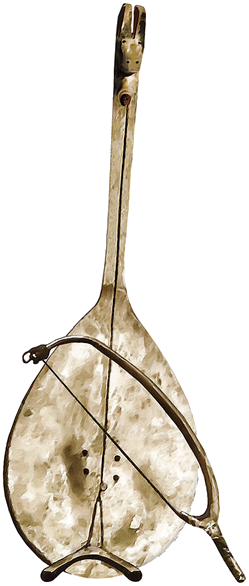
Urbanization and Folklorization of the Ashiq Tradition in Contemporary Iran
By Monire Akbarpouran
Oral Tradition, 37 (2025):71–92
Introduction
A hat, a mustache, an archaic costume.1 In the central square of Zanjān city—a hub where the city’s main streets converge—a group of ashiqs sings, each holding a stringed instrument close to their heart.2 Their aim is to stop passers-by, pull them in, and hold them just a little longer amidst the noise. Most do not stop. Those who do rarely stay until the end of the brief, ten-minute recitation. The ashiq, undeterred, pretends not to notice. He continues to play, unwavering—even as each departure wounds him. I witnessed this scene in Zanjān in 2018. Such scenes—revealing a breakdown in communication between the ashiq and their audience—are not uncommon. Whether in a concert hall or at a picnic, the ashiqs try their luck wherever there are people and no legal prohibitions.3 Yet, wherever they go, they seem out of place—far from the spaces that once welcomed them and from the audience that once knew how to listen. The discomfort beneath their confident appearance emerges clearly upon careful observation and more searching interviews. Why do contemporary ashiqs struggle to communicate as effectively with their communities as their predecessors once did? How does the modern urban context alter the reception of recitations and the ashiqs’ relationship with their audience? To what extent do these recitations differ from traditional ones?
In this study, we use “ashiq” as a general term equivalent to “bard.” However, this designation has only been attested since the 16th century, and exclusively among the Western
1 This research was supported by a doctoral scholarship from the Fonds de recherche du Québec – Société et culture (FRQSC).
2 The expression “holding the saz or qopuz close to their heart” frequently appears in the literature and discourse of the ashiqs, who proudly distinguish themselves from other musicians who do not share the same sacred connection with their instrument. This expression is particularly meaningful because ashiqs also use the term “heart” (ürək) metaphorically in two distinct ways: first, as the site of origin and preservation of their corpus (similar to the English phrase “to know by heart”); second, as the spontaneous source of creativity—as when ashiqs say a word or improvised verse came “into my heart” (ürəyimə düşdü or ürəyimə damdı).
3 According to the “Public Places Rules” decree enacted in 1984, organizing any type of celebration or public event (including weddings and artistic performances) in public places or cafés requires authorization from the Law Enforcement Forces, which is granted only after content review. Though uneven in its application, this decree decisively shapes Iranian public space and has led to ashiqs being prohibited from performing in cafés or wedding halls in certain provinces.
71
Oghuz Turks living in Iran, Azerbaijan, Turkey, and Iraq. Other Turkic-speaking peoples (in Turkmenistan, Uzbekistan, Kyrgyzstan, Kazakhstan, Siberia, etc.) have different terms for professionals who recite their traditional repertoire. This difference in nomenclature is accompanied by variations in form and content across recitation traditions in different cultural regions.4 In recent years, Iranian ashiqs have been targeting festivals and urban event scenes. Encouraged by the inclusion of the ashiq tradition5 in the UNESCO Representative List of the Intangible Cultural Heritage of Humanity in 2009, at the request of the Republic of Azerbaijan,6 these ashiqs have regained their pride. They capitalize on an unparalleled sequence of events: prior to the Islamic Revolution in 1979, they encountered limitations of Turkish cultural expression which were subsequently relaxed in the post-revolution period. Moreover, during the early decades following the revolution, there existed constraints on musical output in general, though these have gradually loosened in recent years. Eventually, a juncture arrived where the government would rather position itself as the primary beneficiary of the burgeoning entertainment sector.
Turkish7 is the second-largest linguistic group in Iran after Persian and its variants. Given the controversial nature of ethnic issues in the country, obtaining reliable statistics is challenging. According to a 2002 survey by the Statistical Center of Iran and the Monde Iranian team of the Centre national de la recherché scientifique (CNRS), 21–22% of the population was Turkophone (Riaux 2011:320). According to the “Languages of the World” statistics published by Ethnologue in 2016, however, Turkophones accounted for only 17–18% of the population.8 In a context where access to written literature for Iranian Turkophones remains restricted, the approximately three thousand members of the House of Iranian Ashiqs align with the Turkish identity movement9 and aspire to embody the Turkish people in the Iranian public space.10
4 Several studies compare Turkish bards across different regions, exploring the overlapping and diverging traditions (Akyüz 2011; Artun 2021; Çobanoğlu 2021). In Central Asia, where shamanic elements are more prominent (Reichl 2001, 2018, 2021), the bard is known as bakşı or bahşı, In Iran, seven cultural zones are distinguished based on practices, instruments, melodies, repertoire, and the social role of the ashiq. For instance, in Iranian Khorasan—linked to Eastern Turkic traditions—the figure of the bakşı exists, whereas in most other areas, oral tradition specialists are called ashiq (Kafkasyalı 2018).
5 I use this term as an equivalent of the Turkic word ashiqliq, which encompasses the entirety of practices, corpus, customs, profession, and affiliation of the ashiqs.
6 For further reference, see UNESCO’s page on the art of Azerbaijani Ashiqs: https://ich.unesco.org/en/RL/art-of-azerbaijani-ashiq-00253.
7 I adopt the terminology used by community members themselves. In this context, “Turkish” refers to ethnic identity and not to the nationality of the Republic of Turkey.
8 https://www.ethnologue.com/country/IR (last consulted in 2021).
9 This movement is a reaction to Persian nationalism (Vaziri 2013) and the assimilative cultural policies arising from the ideal of the nation-state since the late 19th century (Asgharzadeh 2007). Aiming to promote the Turkish cause in Iran, this movement has always been internally diverse and at times controversial (Riaux 2012). The House of Iranian Ashiqs is an NGO founded by Ashiq Seldjuq in 2011; it has taken over from the Iranian House of Music as the body representing ashiqs. It is responsible for organizing festivals, promoting the status of ashiqs, facilitating access to recognition mechanisms such as diplomas, etc.
10 Interview with the founder of the Iranian House of Ashiq, Ashiq Seldjuq, Tehran 2018.
72
The status of the Turkish language in Iran’s public space reflects long-standing sociopolitical contradictions. As Christiane Bulut (2021:288) has observed, despite centuries of political dominance by Turkic dynasties, from the Seljuks to the Qajars, speaking Azeri in public today is often associated with low social prestige. It is perceived as a marker of limited education or lack of refinement, reinforcing patterns of cultural assimilation. The widespread use of Persian has been facilitated by structural factors such as the national education system, modern infrastructure, and the expansion of mass media. The rural exodus and urban migration have further intensified this shift, diminishing the presence of Turkic languages in formal and public settings.
According to the first official census in 1956–1957, the country had 18.95 million inhabitants, with 31% living in cities (Darvishzadeh et al. 2014:62). In 2011–2012, this figure was 75 million inhabitants, with 74% of the population living in urban areas (ibid.). It is also noteworthy that the land reforms of 1963, which abolished feudalism and aimed to sedentarize nomadic tribes, led to a series of bloody rebellions among these peoples and a massive rural exodus (Malek 1966). Although abandoned by the Turkish elite, who inclined towards Westernization, urbanization, and ultimately Persianization, the ashiq tradition has experienced a resurgence in recent decades alongside the emergence of a Turkish identity movement. However, the encounter between the urban audience and the ashiq remains highly problematic.
A Brief Literature Review: Oral Tradition And Contemporary Categories
Oral Tradition, Folklore and Literature
Orality is not merely the absence of writing but a structured mode of civilization ensuring the transmission of a shared cultural heritage (Baumgardt and Derive 2008:17). This perspective diverges significantly from an “evolutionary” view that equates oral tradition with folklore. It does not depict orality as a phenomenon exclusive to an uneducated populace, nor is the popular/scholarly dichotomy relevant. Seydou (1996) highlights how epic storytelling can be institutionalized, with designated “masters of the word” playing a pivotal role in reinforcing communal identity. She recognizes their crucial status in the preservation of epic traditions, showing how their authority is deeply intertwined with social structures and networks of legitimacy. The correlation between the “masters of the word” and their social standing directly influences the type of epic recited and its role within the community. Through comparative analysis, Seydou contends that African epic texts are not merely literary, but serve as social constructs mobilizing communal identity.
This structured social function of oral tradition echoes John Foley’s (1991) concept of “traditional referentiality.” Foley highlights that the meaning of an oral performance is not self-contained but emerges from its relation to a well-established corpus of tradition. When this referential framework weakens, the significance of the performance itself is jeopardized (1–60). Both Seydou and Foley underline the fragile interdependence between oral transmission and its structural anchoring—whether through the social authority of the “masters of the word” (Seydou) or through the continuity of reference within the tradition itself (Foley).
73
Doja (1998) critiques the folklorization of oral traditions, arguing that the modern focus on the so-called folkloric origins of materials—such as poems and narratives—leads to their decontextualization, depriving them of their original significance and reducing them to mere aesthetic or recreational objects. The decline of magical and ceremonial worldviews further accelerates this erosion. Mamadou Diouf (2005) echoes this concern, denouncing the artificial construction of oral literature under Western and writing-centered paradigms, stating that oral compositions are often labeled as literary only in hindsight (37).
Jean During (2014) expands on this process by introducing the concept of “memorialization.” He argues that the patrimonialization of oral traditions, while presented as preservation, often results in their fixation and fossilization. Instead of remaining a dynamic and evolving practice, traditions risk becoming commemorative artifacts, displayed in museums or staged performances, detached from their original social functions (64).
Pascal Boyer (1982, 1984, 1990) explores these dynamics further by analyzing the cognitive mechanisms underlying traditional epics. He defines “traditionality” pragmatically, emphasizing that it is not semantic meaning but the shared knowledge among speakers and listeners that determines an epic’s place in oral tradition. According to Boyer, traditional statements gain credibility not from the speaker but from their perceived external source, such as “ancestors” or “spirits.” Informants evaluate the truth of oral narratives by scrutinizing their origin rather than relying on direct experience. This explains why repetition plays a crucial role, as it strengthens the connection between the present performance and its valued ancestral source. This principle is particularly relevant for the Turkish ashiq tradition, where recitation plays a fundamental role in the continuous reconstruction of tradition (Akbarpouran 2021b:53–55).
Once uprooted from its world, oral tradition undergoes a process of “folklorization” (Doja 1998). Although Doja’s definition of oral tradition may not precisely match that of Africanists, his analysis underlines the global fate of oral traditions: “The focus is now on the so-called popular origin of an element to the detriment of what constitutes its presence within a coherent culture” (96). Alienated from its whole, the folklorized element loses its “original meaning,” as well as its “magical and ceremonial functions,” being replaced by “other functions, distracting and recreational, aesthetic, spectacular, festive, etc.” (106).
Oral Tradition, Professionalization, and World Music
The increasing professionalization of oral traditions does not necessarily imply their disappearance but rather their transformation. Ingrid Åkesson (2011, 2012) examines how traditional singers adapt to a world where orality coexists with structured professional frameworks and digital mediation. Rather than opposing professionalization, oral transmission incorporates new forms of learning, such as recorded materials and institutional training, while retaining oral elements as a marker of authenticity.
Åkesson’s work on Swedish folk music revitalization highlights the tensions between preservation and adaptation, as performers navigate between inherited oral practices and contemporary expectations. Similar dynamics emerge in the ashiq tradition, where musicians use digital platforms to maintain oral transmission while engaging with new audiences. This
74
reconfiguration of tradition in a mediatized environment echoes broader concerns regarding the commodification and deterritorialization of cultural expressions.
While Åkesson focuses on transformations within folk traditions in a European context, other scholars have examined how globalization and the expansion of the music industry have further influenced oral traditions. The rise of World Music since the 1980s has introduced new commercial imperatives that reshape traditional practices, often privileging marketability over cultural continuity. Denis Laborde, who examines the professionalization of two Basque cultural practices for their integration into World Music, critiques this shift (2012:2): “While engagement in tradition was synonymous with altruism, disinterestedness, generosity, humanity, now World Music was destabilizing even the most well-intentioned of traditional musicians.”
Indeed, these “masters of the word” that assert themselves as the only experts in oral tradition are forced to adapt, despite all the disadvantages adaptation represents for them. According to Laurent Auber (2010:26), the declining oral tradition seeks refuge here, sheds its “circumstantial referents” and becomes, like any other music presented in this context, a performance aimed at satisfying the needs of the event or the audience, whether they may be local or international tourists. Traditional music is fundamentally subject to market forces as a consumer product (ibid.). Mallet, who provides an overview on this subject, emphasizes the controversies and contradictions that divide researchers as well as participating musicians (2002:842): “the closer one gets to a World Music ‘creation,’ the more it is a phenomenon largely dominated by technologies, Western circuits, aimed at a post-modern audience.” While acknowledging all that the opportunity to be part of World Music brings to participants, he questions the compromises resulting from the “decontextualization” of traditional music (ibid.). Similar concerns are inherent in concepts such as “commodification” and “deterritorialization” of culture and tradition (Connell and Gibson 2004).
In this regard, Nicolas Canova (2007:3) also laments the shift “from flux culture to stock heritage.” He finds that the folklorization of cultural activities, their transformation into heritage, and their museumification lead to ethical, aesthetic, political, economic, and geographical conflicts around the object in question. Anthropologist Katharina Döring (quoted at Campos 2011:146) also testifies to the “vice of folklore” and “standardization” to which the Portuguese traditional musicians she accompanies in World Music expos, interested as they are in “entering a more professional circuit” and “making a career,” often succumb. These dynamics, widely observed in Western contexts, also resonate—albeit in more abrupt and politically charged forms—in non-Western societies. The case of the ashiq tradition in Iran and Turkey illustrates how the forces of professionalization, modernization, and state-led heritage politics intersect under different historical and cultural constraints.
Turkish Oral Tradition and the Iranian Context
In non-Western contexts, the trend toward “folklorization” is notably more abrupt. Accompanied by Westernization, it disrupts and redefines all cultural practices, including musical traditions, under the guise of modernization (Hassan 2004). E. F. Türkmen (2010:59) investigates the assertion that Âşık Veysel (1894–1973) was the last authentic ashiq, suggesting that contemporary practitioners are merely “modern ashiqs.” She conducts inquiries with experts
75
and researchers regarding the fate of the ashiq tradition in modern Turkey. Türkmen illustrates the controversies surrounding this issue: while some emphasize a clear distinction between folk songs and ashiq poetry, noting their distinct structures and audiences, others commend the innovations emerging after the decline of the traditional master-disciple system, which had a positive impact on literature and music. However, there are those who argue that despite the apparent proliferation of ashiq music, it is undergoing a gradual decline, deviating from its true essence (ibid. 62).11 Continuing these debates, Süleyman Fidan (2017) highlights that the media dissemination of ashiq music—through television, radio, and social media—tends to turn this practice into a consumable product rather than a form of expression rooted in a social and ritualistic framework. Fidan (2018) deepens this issue by examining the representation of ashiqs on television, demonstrating how mediated performances tend to prioritize spectacle and entertainment over the transmission of narratives and values inherent to the tradition. He also, however, nuances this perspective by emphasizing that despite these changes, integration into cultural industries allows ashiqs to reach a broader audience and adapt their practice to contemporary settings, even though it undergoes significant transformations in the process.
Ethnomusicologist Ameneh Youssefzadeh (2005) briefly touches on this issue while addressing other problems. In an article dedicated to regional music in Iran, she makes observations similar to those of Fidan (Youssefzadeh 2005:439). The Iranian ethnomusicologist traces the evolution of the World Music trend in Iran under the auspices of the development of audiovisual technology and festivals, arguing for the need to distinguish between two categories of “regional music”: “professional bardic music” such as the ashiq tradition, and music rooted in folklore. She sheds light on how, from the 1970s onwards and under the influence of interest in World Music, the term “music from different regions” was integrated into official discourse, and how, after the Islamic Revolution of 1987, the term maqami12 was added to reinforce the legitimacy of this music as compared to folk music (419–20).
Youssefzadeh, like Fidan, associates the changes in traditional music with the modernization of the country. She also observes the emergence of a hybrid form of music that blended Persian and Western elements after the 1960s and the growth of the country’s modernization process and increasing attraction to Western culture. According to her, this hybrid music targeted a Westernized urban middle-class audience (427).
During this period, the “educated class” began to embrace both classical and popular Western music, viewing this openness as a mark of progressiveness. Youssefzadeh attributes the
11 In the traditional master-disciple system, masters and knowledgable audiences oversaw the proper transmission of the corpus and prevented major divergences. In the absence of these regulatory mechanisms, ashiqs are increasingly obliged to perform dance tunes and “vulgar” repertoires taken from media-promoted singers, which is fundamentally incompatible with their ethics. Two or three decades ago, no one would have dared to dance in front of an ashiq. Compare the remarks of Ashiq Ali Qaraagaci (2018 interview): “An ashiq was there to speak, to recite, and to say serious and dignified things” (Aşıq fəqət durub çalıb dastan deyəcək idi, nəsihət deyəcək idi, düz əməlli söz danışacaq idi).
12 The term maqâmi (مقامی) refers to Iranian musical traditions that use the muqam modal system, excluding Persian classical music, which developed in royal courts and later in music schools. Though it shares the modal framework, Persian classical music was codified differently through radif and dastgâh. The muqam system is found in several Islamic musical traditions, including those of Iran, Turkey, Azerbaijan, Central Asia, and the Uyghurs of Xinjiang. Though its roots lie in Arab-Persian music theory from the 9th century, its development diverged across regions (During 1988:98).
76
revival of traditional and popular culture during the same era to significant politico-economic shifts. These changes paved the way for the emergence of the first generation of Iranian ethnomusicologists. Notably, Iran, as the leading oil producer in the Middle East, experienced a surge in wealth, which played a crucial role in these transformations. This spurred the industrialization of the country, bolstering the favorable perception of the Iranian monarch among the populace. Additionally, this advancement facilitated the rise of an educated elite, many of whom had received training in contemporary research methodologies at Western universities. Furthermore, Youssefzadeh delineates the festivals and venues that played a pivotal role in this twofold movement: governments invested in regional music to augment Iran’s prestige on the global stage, while ethnic minorities utilized it as a tool for fostering social cohesion and integration (418). The ashiq tradition, along with Turkish music concerts, remains conspicuously absent from studies on musical consumption in Iran. Only one study of Iranian regional music explores the correlation between education levels and musical preferences in Tehran. The findings indicate that only 6.8% of individuals with lower levels of education express interest in regional music, compared to 27.4% for traditional (classical Persian) music and 5.5% for Iranian pop music (Kalantari et al. 2013:123). Here, “regional music” encompasses not only the ashiq tradition but also a wide range of Turkish musical genres and the diverse productions of other ethnic groups such as Lurs, Kurds, and many others.
Methodology
Building on the theoretical perspectives outlined above—particularly the notions of traditional referentiality, professionalization, and folklorization—this study seeks to document how these dynamics unfold in concrete performance settings.13 This paper represents the results of close observations of ashiq recitations in various settings, supplemented by in-depth discussions with the ashiqs, their associates, and also their audiences before and after performances. In 2014, I was able to attend an exclusive event—the Ashiqlar Bayrami festival—held discreetly in a private residence. This clandestine gathering, organized by two activist brothers,14 primarily drew Turkish activists, along with a select group of like-minded ashiqs who shared similar inclinations and were invited to participate. In 2015, I participated in two recitations at wedding celebrations: one in an impoverished neighborhood in Tabriz and another in Tehran, organized by a family that had migrated from a village to the city two generations
13 Recordings of these recitations may be accessed at the following URL: https://www.canal-u.tv/chaines/clermontmsh/hors-champs-videos-hebergees-non-realisees-par-la-msh/anachronisme-koroglu-du. For translations and annotations in French, see Akbarpouran 2021a.
14 Memmed and Mustafa Rezzagi, who, like most Turkish activists advocating for ashiqs in Iran, view the tradition as a core component of Turkish identity (2018 interview, Memmed Rezzagi speaking): “We [the Iranian Turks] have had no schools, no universities, no journals, no media in our language… How could we compete with Persians in written literature? When did we have the opportunity to develop a modern literature like theirs? Never! But when it comes to oral tradition and ashiqs—we are ahead. We have a treasure they do not.” (Bizim dilimizdə mədrəsəmiz, danişqahımız yoxdu… özümüzə dərgimiz, radyo, televizyonumuz yoxdur… Biz necə durub farslar dərəcədə məktub ədəbiyat yaradabilərik? Bizim harda fürsetimiz, imkanatımız oldu ki, onlar kimi modern ədəbiyat yaradaq? Heç vaxt! Amma şifahi gələnəgə, aşığa gəlincə, biz onlardan qabağıq. Bizdə olan xəzinə onlarda yoxdu.)
77
prior. They had invited a young ashiq, who played an electrified version of the traditional instrument, alongside a musician, a vocalist, and a cameraperson.
In December 2016, I was able to observe the festival of Dede ashiq Alsager, hosted by the Iranian House of Ashiqs15 and funded by the Ministry of Culture and Islamic Guidance in Tehran. Subsequently, in spring 2018, I witnessed an annual ceremony organized by the municipal authorities to mark the Iranian New Year in Zanjān’s central square. During this event, five ashiqs performed together, amidst a bustling crowd, singing a song celebrating the arrival of spring and the renewal of nature.
Two months later, in the same city, I attended the Ashiqlar Bayrami festival once more. This time, the event had acquired official recognition and approval from the city authorities after nine years of grappling with threats and logistical challenges.
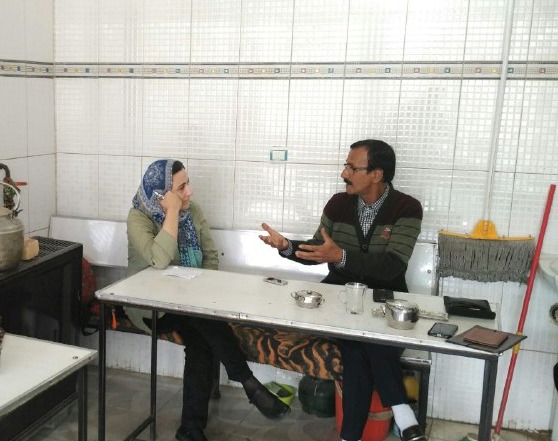
Additionally, during the summer months, I had the opportunity to witness Ashiq Veli’s recitations in a distinctive setting. Every year he ventures to a camp16 near his hometown, where he entertains visitors—Turks, non-Turks, and occasional foreigners—with recitations against a picturesque mountain backdrop. In the summer of 2018, I also observed two recitation sessions by Ashiq Qafar organized by Turkish activists in Tabriz. In one of these sessions, the narrative was left incomplete. The predominantly female activist audience expressed indignation over the hero’s polygamous exploits, despite the ashiq’s efforts to downplay this aspect. In that same year, I ventured to Urmia to witness Ashiq Ali’s performance at his tea house, where only three elderly gentlemen were in attendance.
In all, I conducted twenty-five interviews with different ashiqs in different regions. Across all these encounters, a striking commonality emerged: each recital I observed diverged notably from traditional norms. Particularly when the ashiq adopted a “progressive” approach, any dissatisfied audience member would promptly voice their concerns. This tendency perhaps stems from an assumption that serious observers aim to capture the “lost reality” of the tradition, as articulated by one of the informants. While ashiq recitations do not fall under the category of folklore, they share with oral traditions the fundamental characteristic of community validation.
Results
The Composition and Symbolic Function of Traditional Recitations
Regarding the transformation of recitations, there are some obvious points that the interviews confirm and develop. First, there are many elements absent from modern recitations, such as codified openings and closures, blessing formulas, prayers for future couples, prayers during meals, and improvised praises ordered by guests in honor of the newlyweds and their host. All of these are now categorized as “digressions,” although they once served the traditional ashiqs to develop their argumentation by providing examples and mobilizing common knowledge.
15 İran Aşıqlar Evi (ایران عاشیقلار ائوی).
16 Babək Qalası (بابک قالاسی).
78
In practice, a traditional recitation ceremony comprises several elements, both textual and extratextual. Textual elements encompass the narrative itself and also the non-narrative elements, which often include commentary or interpretation of the narrative.17 Historically, the traditional Azerbaijani18 ashiqs’ repertoire includes extensive narratives known as destans,19 accompanied by a multitude of genres and sub-genres. These encompass riddles, songs covering diverse themes, blessing formulas, proverbs, and anecdotes drawn from everyday life, all of which contribute to elucidating the narrative. Each recitation follows a set of rules the ashiq must respect. It will inevitably include an opening formula and praises of the Prophet of Islam and his successor, Ali. Then the ashiq must recite and sing a genre called “the words of the masters” (ustadname).
The genre of ustadname consists of advice and instructions in verse, addressed by masters to initiated ashiqs. One of the best-known ustadname that have come down to us is attributed to Ashiq Alesger (19th–20th century), in which he invites his disciples to modesty and honesty. Here is an excerpt from this poem, as recited by Ashiq Qafar in 2018:
Aşıq olub, diyar-diyar gəzənin,
Əvvəl, başda pür kamalı gərəkdi.
Oturub-durmaqla ədəbin bilə,
Mərifət elmində dolu gərəkdi.Xalqa həqiqətdən mətləb qandıra,
Şeytanı öldürə, nəfsin yandıra,
El içində pak otura, pak dura,
Dalısınca xoş sədalı gərəkdi.Danışdığı sözün qiymətin bilə,
Kəlməsindən ləlü gövhər süzülə,
Məcazi danışa, məcazi gülə,
Tamam sözü müəmmalı gərəkdi.Arif ola, eyham ilə söz qana,
Naməhrəmdən şərm eyləyə, utana,
Saat kimi meyli haqqa dolana,
Doğru qəlbi, doğru yolu gərəkdi.An ashiq who wanders from land to land
Must, before all else, be complete in virtue.
In every gesture and movement, let courtesy guide him,
17 For more information on these categories and their significance in recitations, see Akbarpouran 2021b.
18 Azerbaijan refers to a large cultural region historically divided: the Republic of Azerbaijan (north) and Iranian Azerbaijan (south).
19 On the term destan and epic discourse, see Akbarpouran 2017.
79
His soul filled with the wisdom of marifat.
He must speak truth to the people,
Strike down Satan and burn away his selfish desires.
Pure in the company of others,
Only then may his voice carry beauty in recitation.He must treasure the worth of each word,
Letting pearls and jewels fall from his tongue,
Speaking and smiling in the language of allegory,
His every phrase clothed in mystery.He must be wise, quick to catch allusions,
Modest and bashful before the unfamiliar,
Turning to God as faithfully as a clock’s hands,
With a sincere heart and a righteous path beneath his feet.
In the ustadname, the ashiqs renew their commitment to the masters from whom they inherited the repertoire. Literary, ritual, and social codes accompany the ashiq and their audience not only during the ceremony, but also before and after.
Norms of Interaction and Ritual Dimension
The interviews confirm that every aspect of the ashiq’s activities was meticulously orchestrated. While not formally documented, specific regulations governed interactions with the public in daily life and with audiences during performances, as well as with fellow ashiqs or event organizers. These interactions were carefully managed across various situations, whether dealing with rival groups, religious leaders, or former patrons such as nobles; in contemporary contexts, it is the parents of the groom who finance the event and determine which ashiq to invite. These guidelines provided a structured framework for conduct in each scenario, fostering smooth and harmonious interactions. The traditional listeners, referred to as “the connoisseurs” (aşıq bilən or aşıq tanıyan) by the ashiqs, were also well-versed in these codes, fostering connection and active participation. This shared understanding facilitated meaningful engagement between the ashiqs and their audience, enriching the overall experience.
In short, traditional recitation at a wedding ceremony, to which ashiqs refer as “true recitation,” involves elements that are absent from the urban setting and are replaced by others that have different effects on social bonds. For example, an ashiq should not sit except during breaks, and the members of the audience should not stand except to pay and place an order. An ashiq should not sit too close to the door or too close to areas reserved for the most prestigious members of the community.20 An ashiq should never present himself at a ceremony assigned to
20 Traditionally, the wall opposite the entrance is considered the “top” of the room, while the entrance wall is the “bottom.” People of higher status are seated against the walls, often on mattresses, while others sit in the middle. Seating reflects one’s rank within the gathering.
80
another ashiq, at least not with his musical instrument, as this signifies a challenge, and the two ashiqs would have to confront each other in a duel. An ashiq should never admit to not knowing the answer to a question or to not being able to recite or sing a piece requested.21 People in the audience might place orders22 to tease or challenge each other, and the ashiq must be vigilant and not fall victim to this game. The ashiq must be served a special meal,23 and so on.
The Crisis of Reception in Urban Contexts
In modern recitations, the epic narrative is either entirely absent or reduced to fragmented and uprooted episodes that the audience struggles to understand and cannot integrate into the overall narrative, let alone into the ashiq tradition. In fact, modern recitations often boil down to a song or chant that does not necessarily belong to the traditional corpus since this does not align with the organizers’ requests and the program’s theme. Furthermore, in modern recitations, the ashiq cannot have the same direct interaction as before. The concept of the stage seems entirely incompatible with the spirit of a traditional recitation where the ashiq walked among the audience, receiving their orders. This prevents the ashiqs from building connections with their interlocutors and significantly diminishes their control. They are no longer the sole person standing. Instead, they are on stage, away from their interlocutors. One ashiq explains (Ashiq Ali Qaraagaci, 2018): “People allow themselves to talk among themselves or leave at their will as if the ashiq is not addressing them!” (Cəmaət Görürsən cəmaəət asşıq oxuya oxuya danışır ya dürüb gedir, heç deyəsən aşıq bulara danışmır!) The disappearance of the role of the commissioner significantly alters the ashiq’s relationship with his audience. It is no longer the audience that commissions and evaluates but the show’s producer, who often lacks a good understanding of the ashiq tradition and only resorts to it to incorporate something “local” into the program.
This structural shift illustrates a broader challenge: integrating into non-traditional settings represents a major challenge for ashiqs, who, unlike their masters, often struggle to connect with the audience, unable as they are to improvise, interact, take control of the performance, or move among the listeners as they once did. This disconnection becomes evident when Ashiq Mehdi, who was receiving signals from the producer to finish his recital as soon as possible, said (author’s recording, 2018): “Now they will say the ashiq tired the audience. But
21 This would be seen as discreditable and shameful. The ashiq must persuade the sponsor gently. One interviewee, a very pious man, told me (Ashiq Gulaga, 2018, Marand): “They asked me for something—how could I take the money and give them something else? I’m going to bring that money home to my wife and children; it wouldn’t be halal. [laughs] But I make it halal in my own way. I say: forget about that one, let me recite you a better one—God willing, you’ll be satisfied. And they usually are.” (Məndən bir zad istiyiblər, necə pulu alıb yerinə ayrı bir zad verim? O pulu mən arvad-uşağıma aparacağam, halal olmaz da. [gülür] Amma mən yolu ilə həlal elərəm. Deyərəm: filankəsi qoy, sənə ondan bir yazmasını deyim, inşallah razı olasan. Onlar da razı olar.)
22 Cultural customs vary by region. Usually, the host—called the master of the wedding—pays a substantial fee to invite the ashiq. Guests then pay extra to make specific requests. The host’s financial and social status determines the prestige of the invited ashiq.
23 The liver and heart of lamb or beef sacrificed during wedding ceremonies are symbolically important offerings.
81
how could people get tired? They are sitting and listening to the ashiq—it’s not like they are harvesting wheat!” (İndi deyəcəklər aşıq cəmaəti yordu. Cəmaət nəyə yorulur axı? Oturub aşığa qulaq asır, zəmî biçmir yorulsun!) Furthermore, the moralistic content of recitations and their adherence to archaic values are increasingly interpreted as violent, misogynous, and brutal, particularly by the middle class.
Generational Tensions and the Redefinition of Legitimacy
Although initially every ashiq presented a discourse marked by pride and confidence, extended discussions have revealed the underlying difficulties they face. With the passing of an older generation who possessed a deep knowledge of tradition and once sustained it by encouraging and commissioning stimulating works for ashiqs, the question arises: who will uphold this legacy? The younger generation, preoccupied with university studies and employment, encounters hardships that hinder active engagement with the tradition. While they express an appreciation of tradition, there are observable shifts in musical and literary preferences among them. Even those who listen to Turkish or Azerbaijani music tend to favor
82
professionally produced works by artists from Turkic-speaking countries over performances by elderly ashiqs, which are often interrupted by “moralizing comments.”24
What the new urban audience considers as moralizing commentary interrupting the narrative, the masters regarded as essential. These were not comments but an important part of the performance. Believing themselves in charge of the people’s education, the precursors of the current ashiqs were recognized by their community as sages, not just narrators of a fictional story. When an ashiq used a marriage episode in the narrative to educate and explain how young girls should behave, these statements, enriched with proverbs and anecdotes, captured the interest of the audience, who were there to learn. People were not annoyed or bored as they are today (Ashiq Boyuk Aga, 2018). The collective lament among ashiqs about having to learn to make or chant “insignificant” songs for contemporary wedding celebrations speaks volumes about this shift in taste.
Meanwhile, as elderly ashiqs complain about the young audience’s ignorance and unwillingness to pay for good recitals, the younger ashiqs regret the shortcomings of their predecessors, such as their lack of education and of knowledge about proper stage or on-screen behavior (Ashiq Ahmad Shahbazi, 2018). One crucial dimension of the traditional ashiq-audience relationship has disappeared in urban settings: the mutual emotional and moral adherence that once bound them. The testimonies and corpus of the ashiqs demonstrate a strong tendency—almost an obsession—to debate ethical and religious questions with religious figures promoting a canonized version of Shiite religion. But the context has now shifted. For at least five centuries, ashiqs constructed their legitimacy by positioning themselves as moral and spiritual guides in contrast to religious authorities. Today, they are compelled to redefine themselves in relation to a new rival figure: the artist.
Having learned their trade by accompanying a master, who was often illiterate, in his recitations, they not only view most modern artistic practices as unworthy of their dedication to their masters and to the people, but also find it challenging to compete with contemporary musicians and singers. Most of these men have learned at most thirty musical tunes, all by ear. In the time of their masters, having a beautiful voice and knowing how to play music were only a small part of the necessary skills. Given their essentially ethical role, which included prayers, blessings, and mediations, the most important aspect was to lead an exemplary life and to serve as a role model.
The traditional ashiqs undertake a diverse array of tasks, serving as arbitrators of social norms and moral codes, educators, storytellers, musicians, poets, officiators of wedding ceremonies, mediators in conflicts, custodians of oral tradition, and more. In essence, they are experts. But experts in what exactly?
According to the discourse of the elder masters regarding their own masters and their masters’ masters: “experts in everything” (Ashiq Ahmad Shahbazi, 2018). In the course of the interviews quoted below, it gradually becomes possible to associate this “everything” with what scholars commonly refer to as “tradition.” Obviously, neither the ashiqs nor their audience employ the Persian or Turkish equivalent of the word “tradition,” not only because the concept is
24 Quotation taken from an interview with a 15-year-old girl who attended the recitation of Ashiq Qafar. She was forced by her mother to do so and was upset about it.
83
absent from their discourse, but primarily because they lack the necessary epistemological distance. They speak of what gives meaning to their lives, even now, even if this thing proves increasingly incoherent and devalued. This “everything” encompasses what one needed to know in a past where modern Persian schools did not exist. Traditional schooling,25 sometimes entrusted to the ashiq, was not accessible to everyone and sought a socialization somewhat different from what the ashiq provided.
From Ceremonial Performance to Entertainment: The Changing Dynamics of Ashiq Tradition in Urban Settings
The transformations described in the previous section point not only to changing formats or venues but also to the redefinition of a social position. The discussion below mobilizes the ashiqs’ own words not as illustrations, but as analytical anchors to grasp how their legitimacy, authority, and relational frameworks are being reconfigured in contemporary Iran.26
A first axis of analysis concerns the requalification of the ashiq’s role. Traditionally, ashiqs functioned as ritual and moral authorities within a system of performance anchored in communal codes. Seydou’s term “masters of the word” applied well to the elderly ashiqs, whose legitimacy derived from both knowledge and ethical standing. Ashiq Boyuk Aga (2018 interview) illustrates this rupture as follows: “If we were as knowledgeable as our masters used to be, young people would come to ashiqs to learn about their identity and their past. But now people go to universities to get their degrees—maybe if we had done the same, it wouldn’t have turned out like this.” (İndi biz ustadlarımız kimi bilgili olsaydıq, cavanlar gəlib aşıqdan kimliyinə görə, keçmişinə görə xəbər alardı. Ancaq indiki cəmaat gedib danışqahlardan mədrək alır, bəlkə biz də alsaydıq belə olmamışdı.) The ashiq is no longer positioned as a source of normative authority; he is compared instead to formally educated performers, and found lacking—not in knowledge of tradition, but in institutional capital.
This shift coincides with the broader process of folklorization, as articulated by Doja and During, in which traditional practices are uprooted from their embedded context and aestheticized for staged presentation. What was once an interactive and ethical performance becomes a cultural product for consumption. Ashiq Mehdi’s reflection encapsulates this process: “Now they would blame me for tiring the audience!” His frustration is directed not only at individual spectators, but at the structural conditions of performance that now prioritize entertainment value over communal meaning.
This transformation must be read alongside Simmel’s (2004) theorization of urban mentality. In the traditional village context, recitation occurred in a space of thick social proximity—an environment in which the performer and the audience were mutually recognizable and ethically engaged. Urban space, by contrast, fosters anonymity, fragmentation, and affective
25 Maktab (مکتب) refers to the older form of education before modern schools were introduced in Iran. Children were taught in the home of a teacher, learning reading, writing, Quranic studies, basic arithmetic, and classical Persian literature (e.g., Saadi).
26 For a description of the fieldwork from which the excerpts below are drawn, see the section on methodology, above.
84
reserve. This shift in mental disposition explains the break in the ashiq-audience relationship. In the traditional setting, this authority was reinforced by a well-known proverb: “The ashiq recites what he sees.” A single verse, uttered during a performance, could carry implicit moral judgment
and affect a family’s reputation. This expressive power was possible only in a context of shared codes and reciprocal recognition, where both performer and audience were socially accountable to one another. As one elderly informant put it (Ashiq Qafar, 2018 interview): “He was their ashiq, they took pride in him.”27 This phrase captures a form of symbolic belonging: the ashiq was not a foreign guest, but a figure of collective identity, embedded in a known moral lineage. Urban settings dissolve these links, leaving the audience unable to recognize, evaluate, or claim the performer as their own. Ashiq Qafar’s use of the word “treasure” (“it seems they had found a
27 Ashiq Qafar (2018 interview): “When an ashiq emerged from a village, everyone was happy; it seems they had found a treasure, and they said, “He is from our village.” Others did not know how to bring him to their own village . . . They took pride and said, “This is our ashiq.” And after all, an ashiq brings baraka (blessing). Other nations have nothing like this — an ashiq who comes to teach words, to bind kinship, to reconcile those who have fallen out.” (Bir kənddən bir aşıq çıxanda hamı sevinərdi, deyəsən gənc tapmışdılar, deyirdi: “O bizim kəndlidi.” O birsilər də bilməzdi necə onu o kəndə aparsın . . . İftixar eliyirdilər, deyirdilər: “Bu bizim aşığımızdı.” Bir də axı aşıq bərəkət gətirər. Ayrı millətlərin belə bir zadı yoxdu ki, aşıq gəlib söz öyrədə, qan bağlaya, küsünü barışdıra.)
85
treasure”) underlines the ashiq’s former symbolic role as keeper of communal wisdom, a status that is unintelligible in a context where affective and moral recognition is absent.
The erosion of ceremonial structure in modern recitations further disrupts the relational ecosystem of traditional performance. In earlier settings, as Monnerie’s (2013) concept of ceremonial competence suggests, participation in recitation was a culturally acquired skill. Audiences were not passive—they posed riddles, made poetic requests, interpreted symbolic commentary. These dynamics disappear in the new format, where the public often lacks both the referential knowledge and the ritual posture to engage. Ashiq Qafar (2018 interview) voices this crisis of reception: “If no one invites the ashiq to weddings, if no one commissions him, if no one sits to listen… if he is not called to festivals, television, or radio—how could he, on his own, awaken the people? But it won’t remain like this. The next generations will be more aware … They will cherish this tradition more than we do, because they will be better educated.” (Aşığı toya aparan olmasa, dərxast verən olmasa, oturub eşidən olmasa… ya festivala, televiziyaya, radyoya çağrılmasa, necə özü tək canına xalqı ayılda bilər? Amma bu belə qalmaz. Gələcək nəsillər daha məlumatlı olacaqlar… Onlar bu ənənəni bizdən daha artıq sevəcəklər, çünki daha savadlı olacaqlar.) His hope for future restoration nonetheless recognizes that the present lacks the social and symbolic framework for full performance.
Some ashiqs emphasize that what is missing today is not merely a repertoire or ceremonial format, but a specific dimension they describe as “spiritual.” As Ashiq Dehqan and his peers often noted, a true recitation must be manavi (معنوی) or ruhani (روحانی)—a performance grounded in a shared ethical and emotional disposition. Without this mutual engagement, the act of reciting loses its depth and transformative potential, reducing the tradition to a hollow performance.
Another layer of transformation lies in the displacement of authority from the commissioner to the producer. In traditional ceremonies, it was the host and audience who commanded the content and flow of performance. Today, the figure who holds power is the event organizer, often unfamiliar with the ashiq tradition. As Ashiq Mehdi observed in one of the recitations interrupted by production timing: “People allow themselves to talk among themselves or leave at their will as if the ashiq is not addressing them!” (Cəmaət görürsən, aşıq oxuya-oxuya danışır, ya durub gedir, elə bil aşıq bunlara danışmır!) This signals not just a breakdown in attention but the absence of shared codes of engagement.
Amid these losses, the ashiqs negotiate visibility through compromise. Ashiq Seldjuq captures this shift with his pragmatic conclusion: “Even if the ashiq tradition disappears, this instrument—this ashiq saz and this music—must survive.” (Aşıqlıq aradan getsə də, bu saz, aşıq sazı və aşıq musiqisi qalmalıdır.) What remains is not the ceremony, not the ethical discourse, but the visual and auditory trace of tradition. In this sense, the ashiq himself becomes what Doja describes (1998): a folkloric figure re-inscribed into the mosaic of national heritage as a cultural signifier more than a social agent.
Other than that, contrary to what Doja observed in Albania, a narrative transcribed at this stage rarely integrates written literature. How could the writing down of a detached anonymous narrative compete with a carefully crafted book that is inherently compatible with dominant aesthetic codes? Even attempts to preserve traditional performances through recording involve adaptation, and the folklore collections and texts that serve as memory aids to contemporary
86
ashiqs themselves carry aesthetic codes that were not those of tradition one or two generations ago. The various components of the traditional ashiq performance are itemized and treated separately. Narratives are classified as folk tales, thus with little regard for their form. Proverbs and sayings may, with some luck, appear in other types of folklore collections. As for poems, they may be recorded more faithfully, but only certain well-known genres are considered “worthy” of preservation. For example, praises and improvised debates never find their place in these collections. But the process of folklorization does not stop there: it is the role and status of the ashiqs themselves that is being folklorized. They are no longer seen as embodiments of ancestral wisdom, but rather as folkloric characters.
The Turkish identity movement applauds their efforts to break out of the traditional framework. Activists support them in their struggle for access to public space in a country where Persian as the official language monopolizes the high-end cultural space. New horizons are opening for them: radio, television, book and CD publishing, festivals, concerts in Iran or even better in neighboring Turkic-speaking countries, and especially on the internet. But the more they acquire the necessary skills to penetrate modern institutions, the more they question themselves and are accused by their more conservative and older colleagues of not being “true ashiqs.”
The marginalized status of the Turkish language and the abrupt modernization of the country have consigned the ashiq tradition to a dual role with contradictory requirements: to flourish in an urban and modern setting, without losing what characterized it in the traditional framework. Torn between their commitment to tradition and the desire to take to the stage to break their isolation and make a living, the ashiqs seize every opportunity and do their best to attract the urban public: they abandon a large part of the traditional practices and borrow new ones from their artistic competitors. But the acquisition of these skills increasingly assimilates them to their rivals, singers and musicians, without bringing them the popularity of the latter.
Yet even within this reorganization, the ashiqs articulate a form of reflexive critique. Their narratives are not only nostalgic; they are also diagnostic. Each of the above quotations—Boyuk Aga’s assessment of legitimacy, Mehdi’s frustration with framing, Dehqan’s sense of lost resonance, Qafar’s vision of possible continuity—contributes to a situated theorization of what is vanishing and what might still be salvaged.
This discussion thus shows that the passage from ceremonial performance to public-stage entertainment is not a linear decline, but a complex reconfiguration. It brings into focus the collapse of shared referentiality (Foley 1991), the transformation of the performer’s status (Seydou 1996; Doja 1998), the fragmentation of social intimacy (Simmel 2004), and the dissolution of audience competence (Monnerie 2013). Through this layered process, the ashiq tradition remains active—but transformed, uncertain, and self-aware of its own fragility in the urban present.
Conclusion
The analysis above explored four key aspects of this transformation: the erosion of textual and ritual composition, the loss of interactional norms and ceremonial knowledge, the fragmentation of audience reception in urban settings, and the generational tensions surrounding
87
legitimacy and moral authority. These transformations reveal broader socio-political tensions shaping the ashiq tradition today.
The transformation of recitations within the ashiq tradition in Iran reflects a profound shift from ceremonial performance to entertainment, driven by urbanization and changing audience expectations. Traditional recitations, characterized by intricate codes and rituals, have been gradually replaced by modern renditions that lack the depth, interactive format, and symbolic authority of their predecessors. The disappearance of elements such as codified openings and closures, prayers, and blessings illustrates not only a loss of form but also a weakening of the normative function once embedded in the tradition.
Moreover, the Simmelian perspective offers valuable insights into the changing dynamics of the ashiq-audience relationship in urban settings, alongside the disappearance of ceremonial mentality that accompanied traditional recitations (see Simmel 2004). The increasing mental distance between individuals in metropolitan areas undermines the intimate connections and collective commitment once inherent in ceremonial performance. As urban audiences become more heterogeneous and detached, the traditional role of the ashiq as an arbitrator of social norms and moral codes diminishes, relegating them to the status of mere entertainers or symbols of a threatened identity.
Furthermore, this process goes hand in hand with folklorization, a dynamic that not only affects the content of recitations but also reshapes the perception of the ashiqs themselves. Once revered as embodiments of ancestral wisdom, they are now viewed as folkloric characters, detached from their original context and significance. They assume the role of guardians of a folkloric and museological object, and they take part in the “rainbow of Iranian ethnicities,” performing on the margins of different television shows or festivals.
In essence, the transformation of recitations within the ashiq tradition highlights the complex interplay between oral tradition, modernity, and urbanization. While some lament the loss of traditional practices and values, others see opportunities for innovation and adaptation. The ashiqs themselves offer a reflexive diagnosis of this moment: their narratives are not merely nostalgic but serve as testimony to a living tension between memory and change. Ultimately, the future of the ashiq tradition will depend on its capacity to assert its cultural relevance in contemporary institutional, artistic, and political contexts—without severing the ties that once anchored it to its community-based authority.
Institut national de la recherche scientifique, Montréal
References
Akbarpouran 2017
Akbarpouran, Monire. “Le destan turc est-il une épopée? Premiers débats et prolongements actuels.” Le Recueil Ouvert, 3. http://epopee.elan-numerique.fr/volume_2017_article_283-le-destan-turc-est-il-une-epopee-premiers-debats-et-prolongements-actuels.html
Akbarpouran 2021a
______. Koroğlu du XXIe siècle et les Aşiq iraniens. Istanbul: Isis.
88
Akbarpouran 2021b
______. “L’espace ordonné de la cérémonie pour conjurer l’espace angoissant des conquêtes: L’imaginaire des traditions épiques turcomanes (Le Livre de Dede Korkut, Le Livre de Dede Korkut qadjar et les destan iraniens de Koroğlu).” Revista Épicas, 10:45–63.
Åkesson 2011
Åkesson, Ingrid. “Participation, Orality and Multidirectional Music-Making in a Mediatized and Professionalized World.” In Current Issues in European Cultural Studies, June 15–17, Norrköping, Sweden, 2011. Ed. by Martin Fredriksson. Linköping: Linköping University Electronic Press. pp. 521–26.
Åkesson 2012
______. “Oral/Aural Culture in Late Modern Society? Traditional Singing as Professionalized Genre and Oral-Derived Expression.” Oral Tradition, 27.1: 521–26. https://journal.oraltradition.org/wp-content/uploads/files/articles/27i/03_27.1.pdf
Akyüz 2011
Akyüz, Çiğdem. “Dünden bugüne türk dünyası destan anlatıcıları.” Turkish Studies, 6:15–26.
Artun 2021
Artun, Erman. Aşıklık geleneği ve aşık edebiyatı edebiyat tarihi/metinler. Adana: Karahan.
Asgharzadeh 2007
Asgharzadeh, Alireza. Iran and the Challenge of Diversity: Islamic Fundamentalism, Aryanist Racism, and Democratic Struggles. New York: Springer.
Aubert 2010
Aubert, Laurent. “Du ‘bon usage’ des musiques du monde: Questions sur une éthique de la diversité culturelle.” Les Cahiers de la Société québécoise de recherche en musique,11.1: 21–29.
Baumgardt and Derive 2008
Baumgardt, Ursula, and Jean Derive, eds. Littératures orales africaines: Perspectives théoriques et méthodologiques. Paris: Karthala.
Boyer 1982
Boyer, Pascal. “Récit épique et tradition.” L’homme, 22.2:5–34.
Boyer 1984
______. “La tradition comme genre énonciatif.” Poétique, 58:233–51.
Boyer 1990
______. Tradition as Truth and Communication: A Cognitive Description of Traditional Discourse. Cambridge: Cambridge University Press.
Bulut 2019
Bulut, Christiane. “The Turkic Varieties of Iran.” In The Languages and Linguistics of Western Asia: An Areal Perspective. Ed. by Geoffrey Haig and Geoffrey Khan. Berlin: De Gruyter Mouton. pp. 398–444.
89
Campos 2011
Campos, Lucia. “Sauvegarder une pratique musicale? Une ethnographie du samba de roda à la World Music Expo.” Cahiers d’ethnomusicologie, 24:143–55.
Canova 2007
Canova, Nicolas. “Après le développement durable . . . Un retour à une authenticité culturelle.” 1er colloque de l’ENEC, France. https://shs.hal.science/halshs-00923053/document
Çobanoğlu 2021
Çobanoğlu, Özkul. Aşık tarzı kültür geleneği ve destan türü. Ankara: Akçağ.
Connell and Gibson 2004
Connell, John, and Chris Gibson. “World Music: Deterritorializing Place and Identity.” Progress in Human Geography, 28.3:342–61.
Darvishzadeh et al. 2014
R. Darvishzadeh, A. Poorahmad, H. Mansourian, and F. Seifolddini. “Processes and Patterns of Urbanization in Iran. Journal of Urban-Regional Study and Research, 6.21:61–84.
Diouf 2005
Diouf, Mamadou. “L’invention de la littérature orale: Les épopées de l’espace soudano-sahélien.” Études littéraires, 24.2:29–39.
Doja 1998
Doja, Albert. “Évolution et folklorisation des traditions culturelles.” East European Quarterly, 32.1:95–126.
During 1988
During, Jean. La musique traditionnelle de l’Azerbaïdjan et la science des muqâms. Baden-Baden: Valentin Koerner.
During 2014
______. “Pour une déconstruction des corpus musicaux canoniques d’Asie intérieure.” Anthropologie et sociétés, 38.1:63–84.
Fidan 2017
Fidan, Süleyman. Âşıklık geleneği ve medya endüstrisi—geleneksel müziğin medyadaki serüveni. Ankara: Grafiker Yayıncılık.
Fidan 2018
______. “Televizyonda aşıklık geleneğinin temsili üzerine bir değerlendirme.” In Motif vakfı uluslararası sosyal bilimler sempozyumu. Ed. by Mustafa Aça. Çanakkale: Motif Vakfı. pp. 149–56.
Foley 1991
Foley, John Miles. Immanent Art: From Structure to Meaning in Traditional Oral Epic. Bloomington: Indiana University Press.
Hassan 2004
Hassan, Schéhérazade Qassim. “Tradition et modernisme: Le cas de la musique arabe au Proche-Orient.” L’homme, 171–172.3–4:353–69.
Kafkasyali 2018
Kafkasyali, Ali. İran türkleri aşık muhitleri. Erzurum: Salkımsöğüt.
90
Kalantari et al. 2013
Kalantari, Abdolhosein, Valiolah Rostamalizadeh, and Azam Nasimafza. “Education and Cultural Consumption in Tehran.” Quarterly of Social Studies and Research in Iran, 2.1: 111–31.
Laborde 2012
Laborde, Denis. “Faire profession de la tradition?” Cahiers d’ethnomusicologie,25:205–18.
Malek 1966
Malek, Hossein. “Après la réforme agraire iranienne.” Annales de géographie, 75.409: 268–85.
Mallet 2002
Mallet, Julien. “World Music: Une question d’ethnomusicologie?” Cahiers d’études africaines, 168.4: 831–52.
Monnerie 2013
Monnerie, Denis. “Expériences, performances et compétences dans les cérémonies kanak (Arama et Hoot Ma Whaap, Kanaky Nouvelle-Calédonie).” In Compétence et performance: Perspectives interdisciplinaires sur une dichotomie classique. Ed. by Sylvie Fortin and Claire Leguy. Paris: Karthala. pp. 267–99.
Reichl 2001
Reichl, Karl. “L’épopée orale turque d’Asie centrale.” Études mongoles et sibériennes, centrasiatiques et tibétaines, 32:9–37.
Reichl 2018
______. Turkic Oral Epic Poetry: Traditions, Forms, Poetic Structure. London: Routledge.
Reichl 2021
______. The Oral Epic: From Performance to Interpretation. London: Routledge.
Riaux 2011
Riaux, Gilles. “Téhéran et ses provinces: L’hypothèse de l’émergence de sous-champs politiques dans les régions périphériques de la République islamique.” Outre-Terre, 2:319–28.
Riaux 2012
______. Ethnicité et nationalisme en Iran: La cause azerbaïdjanaise. Paris: Karthala.
Seydou 1996
Seydou, Christiane. “L’épopée, genre littéraire ou institution sociale? L’exemple africain: L’épopée: mythe, histoire, société.” Littérales, 19:51–66.
Simmel 2004
Simmel, Georg. “Métropoles et mentalité.” In L’école de Chicago: Naissance de l’écologie urbaine. Ed. by Yves Grafmeyer and Isaac Joseph. Paris: Aubier. pp. 61–77.
91
Türkmen 2010
Emel Funda Türkmen. “Halk Müziğindeki Değişimler Ve Halk Müziği Eğitimine Etkileri.” Kuramsal eğitimbilim dergisi, 3.2:53–68.
Vaziri 2013
Vaziri, Mostafa. Iran As Imagined Nation. Piscataway, NJ: Gorgias.
Youssefzadeh 2005
Youssefzadeh, Ameneh. “Iran’s Regional Musical Traditions in the Twentieth Century: A Historical Overview.” Iranian Studies, 38.3:417–39.
92